
America’s Got Talent has built its reputation on spectacle, danger, surprise, and voices powerful enough to fill a theater in seconds. This audition stood apart because one performer arrived with no backing track, no elaborate staging, and no obvious fit inside the show’s usual categories.
Brandon Leake, 27, from Stockton, California, entered as the program’s first spoken word artist, which made his appearance feel uncertain before it became moving. His act asked the judges and audience to lean in, listen closely, and accept poetry as a mainstage performance rather than a classroom exercise or coffeehouse form.
Before stepping onto the stage, he framed his story through family, survival, and the place that shaped him. He described growing up near hardship, with violence and instability around him, while his mother worked constantly to keep him protected and supported.
That background did not arrive as a grab for sympathy, but as context for why writing mattered. He explained that words became a way to handle anger, pain, and pressure that might otherwise have swallowed him.
The audition also carried urgency because he had recently become a father. His daughter was only 14 days old, and he spoke about wanting more time with her, more creative freedom, and a future built around the art that had already guided his life.
His professional life already connected performance with service. He worked as a counselor and educator, ran poetry workshops for young people, and used spoken word as a tool to help others find language for experiences they might not know how to express.
When he reached the judges, their questions reflected both curiosity and uncertainty. Spoken word had not been part of the show’s regular audition language, so they asked what he did, how he defined it, and where he hoped it could take him.
He answered with clarity and ambition. His dream was not only to perform poems, but to build a one-man show that could travel, reach audiences, and prove that storytelling alone can carry dramatic weight.
The poem he chose was deeply personal, dedicated to his sister Danielle “Puff” Gibson. Rather than explaining grief from a distance, he invited the room into a relationship built from childhood memory, affection, teasing, admiration, and loss.
His delivery was calm, measured, and precise. He did not force tears or chase volume, which made the emotional turns feel more intimate and more difficult to ignore.
The early moments of the poem established love through detail. He evoked a sibling bond shaped by closeness, memory, and the kind of private family language that turns one person into a whole world for another.
As the piece unfolded, tenderness met pain. The poem moved between remembrance and absence, showing how grief can preserve someone vividly while also making their absence feel present in every line.
That balance gave the audition its force. It was not only a tribute to a sister, but also a portrait of how loss changes the person left behind.

The room’s energy changed as he spoke. What began as polite attention became stillness, and that stillness became visible emotion among judges and audience members.
This shift mattered because spoken word depends on trust between performer and listener. Without music or visual distraction, every pause, phrase, and breath had to hold attention, and his control over pacing made silence part of the performance.
The judges appeared affected not by technical flash, but by honesty and originality. Their reaction suggested that the audition had expanded their idea of what belongs on a talent competition stage.
The performance also challenged assumptions about scale. Talent shows often reward louder, faster, or more physically demanding acts, but this moment proved that restraint can create its own kind of spectacle.
His poem worked because it trusted emotional specificity. By focusing on one sister, one bond, and one wound, he reached something broad without becoming vague.
The audition’s novelty could have been a risk. If the performance had felt too small for the room, spoken word might have seemed like a thoughtful idea better suited for another venue.
Instead, the room adapted to him. The judges stopped treating the act as an experiment and began receiving it as a complete performance with structure, rhythm, stakes, and emotional payoff.
His presence also gave the episode a different kind of representation. He arrived not as a singer, dancer, comic, or magician, but as an artist whose main instrument was memory shaped through language.
That made the audition meaningful beyond one personal story. It offered a reminder that performance can come from lived experience, careful writing, and the courage to speak without disguise.
The family element gave the piece its emotional anchor. His mother’s sacrifices, his sister’s memory, and his newborn daughter formed a line across generations, showing how love can both wound and sustain.
His desire to turn art into a full-time life felt grounded rather than glamorous. He wanted success, but he also wanted time, purpose, and a way to build a future that matched the lessons his family had given him.
That grounded quality helped prevent the audition from feeling manufactured. Even within a highly produced television format, his story carried the texture of someone who had lived with these words long before cameras arrived.
The poem’s subject could have made the moment heavy, but it was not defined only by sadness. Its strength came from the way it honored joy, humor, and tenderness before confronting absence.
That approach made the grief more human. Viewers were not asked to mourn someone they had never met in abstract terms, but to understand why she mattered through the memories he chose to keep alive.
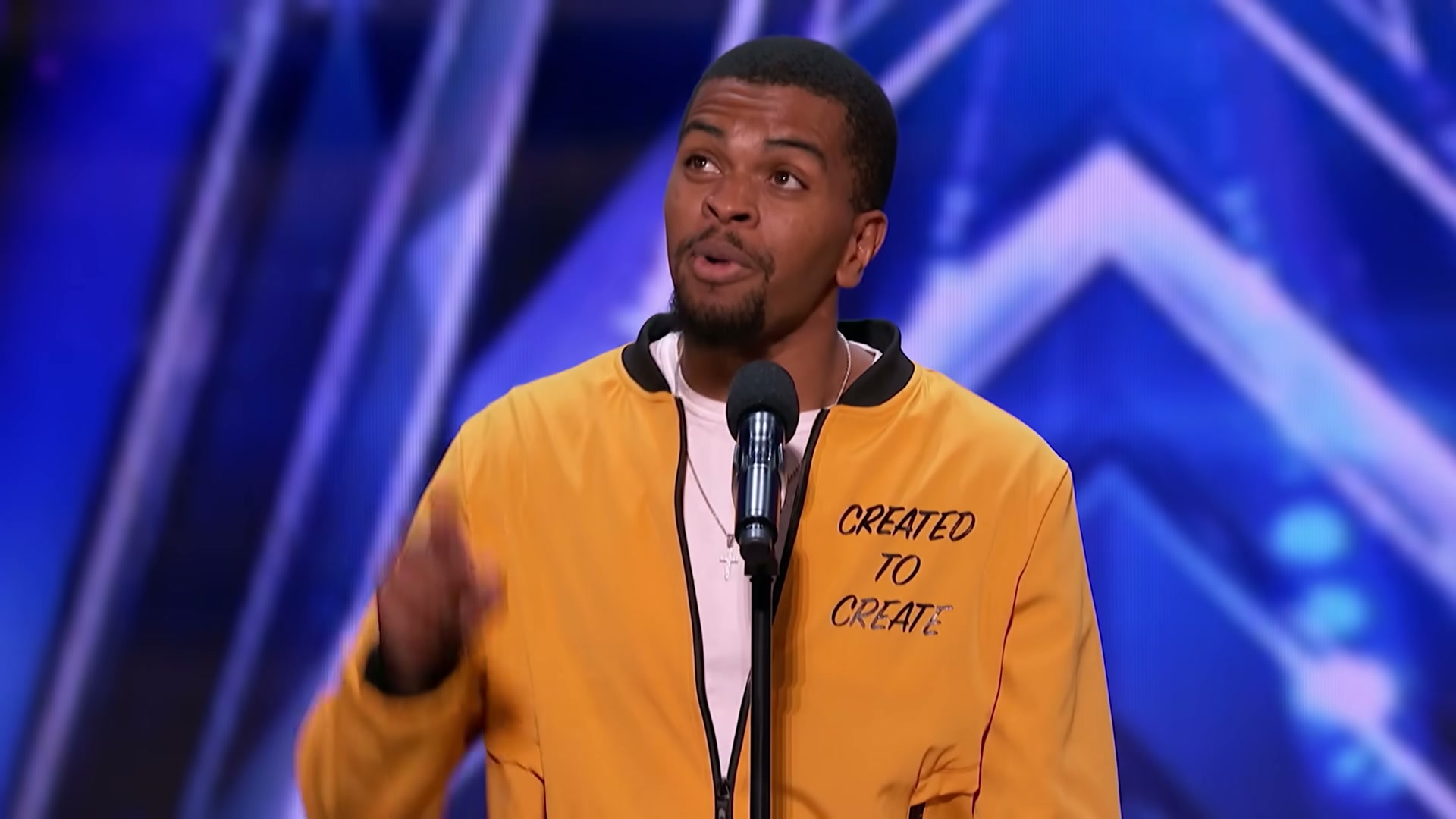
His performance also underlined spoken word’s relationship to breath and body. Though he stood nearly still, his voice, pauses, posture, and eye contact created movement inside the room.
This was why the act translated to television better than skeptics might expect. Close listening became visual because the judges’ faces, audience stillness, and performer’s control turned listening into action.
The audition’s Golden Buzzer framing added to its landmark status. Whether viewed as a competition moment or a cultural one, the response suggested that originality and emotional truth can cut through crowded talent formats.
It also showed why risk matters on such shows. A familiar act can impress, but an unfamiliar one can reset expectations when it succeeds.
For Brandon, the stage represented more than validation. It was a chance to show that the work he had done in workshops, schools, and personal notebooks could stand beside more traditional entertainment forms.
For the audience, the audition offered a rare pause. In a setting often designed for instant applause, his poem asked for patience before delivering impact.
That patience paid off in the reaction that followed. Judges and viewers seemed moved not because they were told to be, but because the performance gave them enough space to arrive there themselves.
The audition’s craft should not be overlooked beneath its emotion. The poem had a clear subject, a controlled arc, strong imagery, and a performance style that matched its intimate content.
Its restraint was especially important. By avoiding overstatement, he allowed each line to carry weight and gave the audience room to feel instead of being pushed toward feeling.
This is what made the moment feel like a breakthrough for spoken word on the show. It was not merely accepted as a novelty, but embraced as a legitimate form of live competition performance.
The audition also connected personal healing with public art. His writing began as an escape from anger and hardship, but onstage it became a bridge between his private grief and a room full of strangers.
That transformation gave the performance its lasting power. It showed how one carefully spoken poem can hold family history, community struggle, artistic ambition, and love without needing anything extra.
By the end, the judges were not simply evaluating a contestant. They were responding to a person who had turned memory into performance and pain into language precise enough to move an entire theater.
The moment endured because it expanded what the stage could contain. A single voice, carrying one sister’s memory and one father’s hope for the future, became enough to make spoken word feel unforgettable.