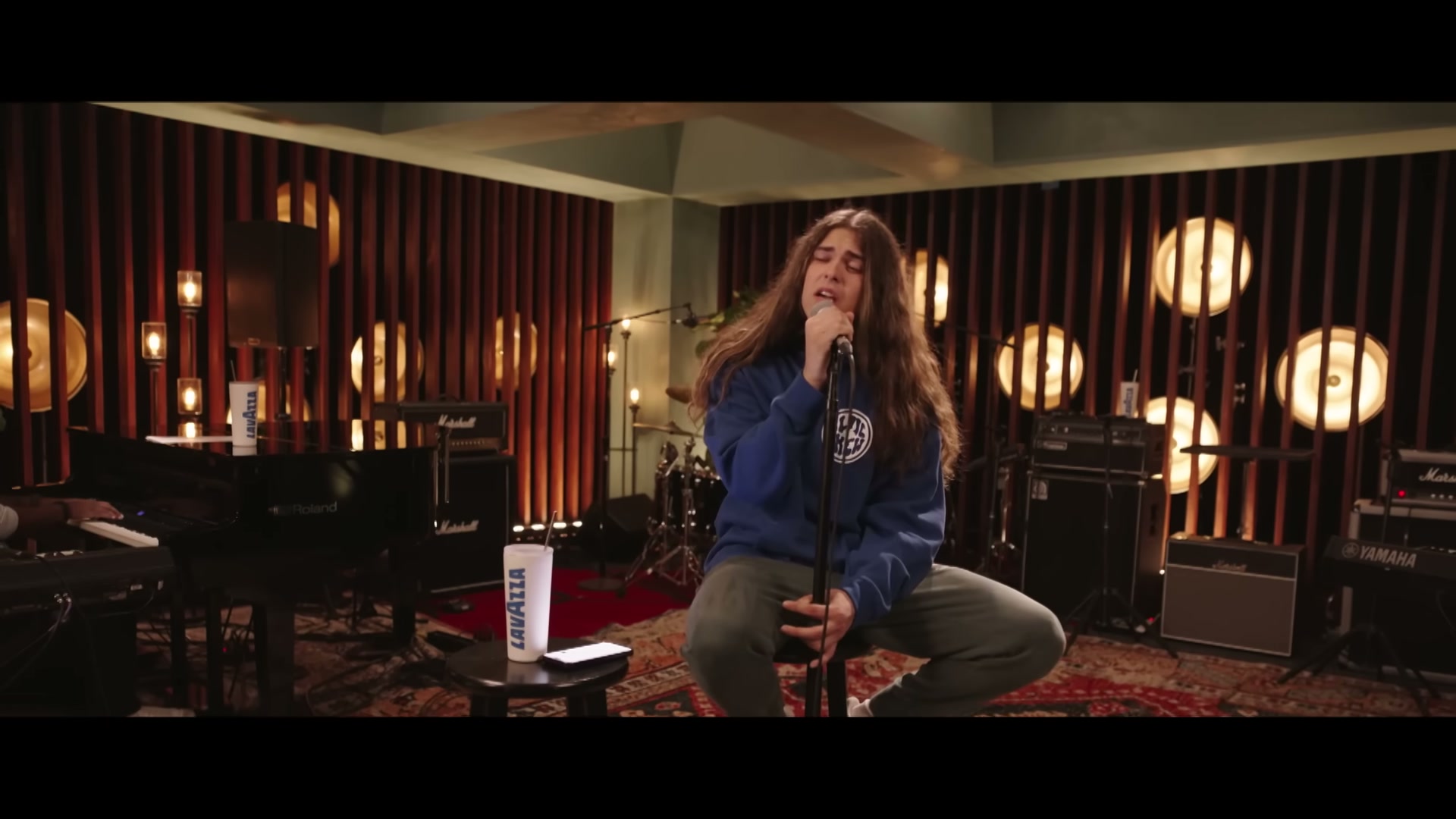
Stepping into the AGT Music Room, Jourdan Blue traded the bustle of public performance for a setting that felt almost conversational, giving his cover of Unsteady a close range intensity that immediately shifted attention from spectacle to story. The segment presented him not simply as a contestant delivering another song, but as an artist using a quieter room, fewer distractions, and a more exposed arrangement to show where his voice and motivations truly come from.
Blue said the stripped back format felt right for him, even if it contrasted sharply with the more chaotic environments where he often sings, because intimacy has always been central to the way he connects with listeners. In the Music Room, that instinct had space to breathe, and the production stayed light enough to let every pause, every softened note, and every glance carry emotional weight without being crowded by noise.
Reflecting on how he began, Blue pointed to church as the place where singing first became part of his life, a foundation that shaped both his musical instincts and the sincerity he now tries to bring to any performance. That background helps explain why a minimalist arrangement suits him so well, since church singing often depends less on effects than on conviction, phrasing, and the ability to move people with honesty.
He contrasted those early experiences with the realities of performing in New Orleans, where music fills the streets but attention is never guaranteed, and where one performer can be competing at any moment with a nearby bar, a passing crowd, or a marching band. In that setting, volume and stamina matter, yet the Music Room asked for something different, inviting him to lower the temperature and trust that stillness could pull people in more effectively than sheer force.
That shift in context gave the segment its central tension, because the singer was no longer trying to cut through competing sounds and instead had to stand inside the song with very little to hide behind. The result was revealing from the outset, with his comments and demeanor suggesting that the room allowed him to present himself more fully as a vulnerable storyteller rather than a polished act built for quick impact.
The conversation then turned to the person he described as his greatest inspiration, his son, and the mood of the piece deepened as he explained how fatherhood changed the meaning of his ambitions. Before becoming a parent, he suggested, music was a dream he hoped might work out, but after his son arrived it became a responsibility, a path toward providing stability, and a purpose that could not be treated casually.
His remarks were simple, but they carried the kind of pressure many working artists recognize, the difference between creating because one wants to and creating because other people now depend on the outcome. In a competition setting, that distinction can sharpen every performance, and here it gave his song choice and his delivery an added layer of urgency without making the moment feel calculated.

Blue said he only likes to sing songs he genuinely connects with, arguing that an audience can tell when a performer actually feels the material instead of merely reproducing its notes. That belief framed his decision to take on Unsteady, a song already associated with emotional vulnerability, and to approach it less as a familiar hit than as a personal confession.
Before beginning, he mentioned bringing the song down to a lower key, a small technical adjustment that said a great deal about the interpretation he wanted to offer in the room. Rather than reaching for dramatic peaks, the lower register made the performance feel more inward, as though he were speaking through melody and allowing fragility to replace flash.
Once he started singing, the stripped back approach paid off immediately, because every part of the arrangement seemed designed to preserve closeness and make the emotional tremor in the lyrics easier to hear. The room was quiet enough that his breathing, the softness of his entrances, and the restraint in his phrasing became as expressive as the words themselves.
His voice carried tenderness, but there was also tension underneath it, the kind that comes when a singer appears fully aware of the stakes attached to what he is trying to communicate. That balance between control and openness kept the cover from tipping into sentimentality, allowing it to remain grounded, human, and believable throughout the performance.
Because the song deals with instability and the fear of things coming apart, his interpretation benefited from the personal context he had already shared, especially the way fatherhood had raised the emotional cost of every career decision. Listeners were not just hearing a recognizable chorus performed well, they were hearing someone connect the song’s uncertainty to his own desire to build something dependable for his child.
The AGT Music Room format also helped emphasize a broader truth about televised talent shows, namely that some of the most memorable moments arrive when production scales down instead of up. By removing visual clutter and performance pressure, the segment let personality, history, and intention do the heavy lifting, which in Blue’s case highlighted a sincerity that might be harder to notice in louder settings.
Even the transition from interview to song felt carefully revealing, as his explanation of why he chose the track made the performance seem like a continuation of conversation rather than a separate showcase. That seamlessness gave viewers a clearer sense of who he is as an artist, someone guided less by display than by emotional alignment with the material he sings.
As the cover progressed, his face and body language reinforced the vulnerability in the arrangement, communicating concentration, care, and a willingness to stay present inside the song’s ache. Nothing about the delivery suggested routine, and that absence of detachment mattered, because it invited the room to respond not as consumers of content but as witnesses to a meaningful personal statement.
When the last notes settled, the response in the room was warm and immediate, with appreciative praise and thanks that confirmed the performance had reached people on the intimate terms it set out to create. The reaction was not explosive in the usual competition sense, but it felt more telling than volume, reflecting the quiet respect that often follows a genuinely affecting rendition.
For viewers, the segment offered a useful reminder that Blue’s appeal does not rest solely on vocal ability, though the performance clearly showcased his control, tone, and instinct for phrasing. Just as important was the way he linked those skills to lived experience, turning technical choices such as dynamics and key into extensions of a story about belief, pressure, and the desire to provide.
That combination may be why the Music Room rendition stood apart from more conventional audition clips, which often depend on surprise, speed, or spectacle to leave an impression before the next act appears. Here, the lasting impression came from patience, from hearing a singer slow everything down long enough for the meaning behind the performance to become impossible to miss.
In that sense, the clip functioned as both performance and portrait, sketching a musician whose path runs from childhood church singing to demanding street corners and now to a national stage where personal stakes are plainly visible. Each part of that journey informed the two or three minutes on screen, giving the cover a sense of continuity and making his vulnerability feel earned rather than manufactured.
The understated success of the moment also suggested why audiences continue to respond to artists who reveal the reasons behind their songs instead of treating music as a sealed off performance object. By speaking openly about inspiration, responsibility, and connection before he sang, Blue made the cover easier to enter, and once inside, listeners could hear not just a song but a motive.
For a brief stretch in a quiet room, the competition framework faded into the background, replaced by the more durable image of a father, singer, and storyteller trying to steady his future through music. That is what made this version of Unsteady resonate beyond its familiar melody, because it transformed a well known song into a plainspoken statement about hope, pressure, and the kind of love that turns artistic ambition into something necessary for his family and for himself every single day.