
Daytime television often works best when a celebrity guest is given a simple premise and enough room to reveal a little personality, and this segment leaned fully into that formula. Built around a cheeky vocabulary game called “Butt Wait, There’s More,” the bit used pop culture familiarity, competitive banter, and audience reaction to turn a silly word challenge into an energetic comic showcase.
Ellen DeGeneres opened the moment by welcoming Nicki Minaj back to the show and framing her guest as a performer with verbal skill, calling attention to her reputation for lyrical confidence. That setup mattered because the game was not presented as a random stunt, but as a playful test of speed, memory, and linguistic creativity tied to Minaj’s public image.
The connection to “Anaconda” was immediate, with the song’s recognizable hook helping establish the tone before the rules were even fully explained. Rather than attempting a serious interview beat, the show used the song’s cultural footprint as an invitation to laugh at the exaggerated language surrounding dance, glamour, and body focused pop performance.
The rules were simple enough for a studio audience to grasp instantly, which is one reason the segment moved so quickly. Ellen and Minaj would alternate naming acceptable words or phrases for the backside, with no repeats allowed and a buzzer waiting to end the round once the pace broke down.
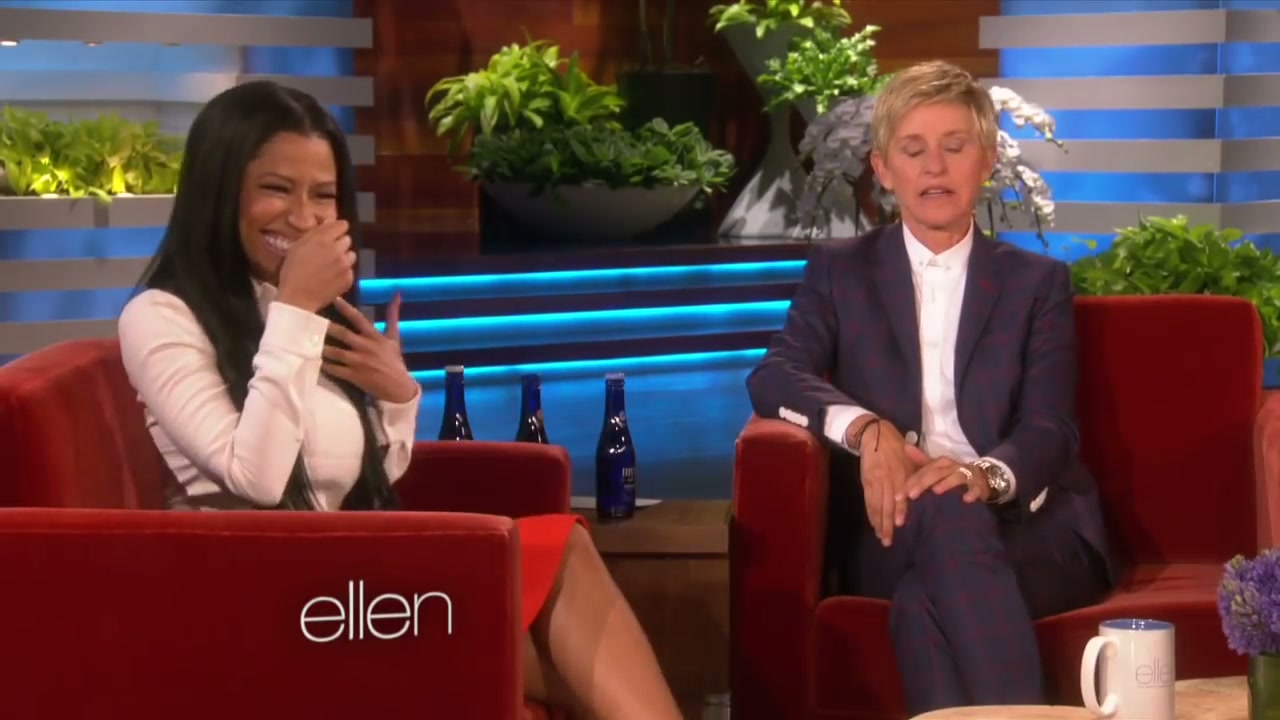
That simplicity allowed the comedy to come from personality instead of mechanics. Minaj entered the game amused and slightly incredulous, while Ellen played the cheerful instigator, smiling through the rules and clearly ready to test how far a daytime friendly vocabulary list could stretch.
The first exchanges moved briskly through familiar terms, including polished words, playful slang, anatomical references, and phrases commonly heard in music or comedy. Each answer raised the stakes a little, not because the subject was complex, but because the participants had to keep finding new ways to describe the same thing without stumbling or duplicating one another.
Minaj showed sharp timing throughout the game, reacting not only to Ellen’s answers but also to the audience’s murmurs and laughter. Her best moments came when she seemed to hover between disbelief and delight, as if she could not quite believe this was the official game she had been asked to play on daytime television.

Ellen’s role was different but just as important, because she kept the rhythm loose and mischievous. She offered answers with the confidence of someone who knew a few of them might be challenged, then waited for Minaj to object, turning each disputed term into a fresh laugh rather than a procedural pause.
Some of the funniest tension came when Ellen tested the limits with borderline entries such as “can” and “tailfeather.” Minaj challenged those answers with mock seriousness, accusing Ellen of bending the rules and making the game feel less like a vocabulary contest than a friendly argument at a party.
The audience became a third participant in the exchange, reacting loudly whenever an answer seemed clever, questionable, or possibly repeated. Their laughter, cheers, and audible surprise helped shape the rhythm, giving the performers instant feedback and making the smallest rule dispute feel like a shared event.
That interaction also showed why celebrity talk show games often rely on looseness rather than precision. If the rules had been enforced too strictly, the segment would have become a dry list, but the loose judging allowed comic uncertainty to keep building as both players argued, laughed, and tried to remember what had already been said.
Minaj’s competitive streak gave the bit its spark, especially when she objected to answers she believed had already been used or should not qualify. She did not simply sit back and play along passively; she leaned into the challenge, questioned the host, and made her amusement part of the performance.
Ellen, meanwhile, understood exactly how to position herself as the provocateur without overpowering the guest. By stretching definitions and acting as though her most debatable answers were perfectly ordinary, she created openings for Minaj’s reactions, which became the centerpiece of the comedy.
The segment’s humor depended on suggestion more than shock, a balancing act that daytime shows frequently attempt but do not always manage smoothly. Here, the subject was obviously playful and a little saucy, yet the presentation stayed light enough to fit the setting, relying on euphemism, sound effects, and facial reactions instead of anything mean spirited.
That balance was helped by the obvious rapport between the two performers. Minaj appeared comfortable laughing at the premise, challenging the host, and letting the game poke fun at the image attached to one of her biggest hits, while Ellen kept the environment buoyant and nonjudgmental.
The title “Butt Wait, There’s More” captured the segment’s entire attitude, combining a familiar television phrase with a wink at the game’s theme. It was corny by design, but that corniness was part of the appeal, signaling to the audience that everyone involved was invited to treat the premise as ridiculous fun.
As the round continued, the answers became more frantic and the memory challenge more visible. Both players had to track not only their own words but each other’s, which gave rise to accusations of repetition and prompted quick consultations with the audience’s collective memory.
Those disputes gave the segment its most natural comic beats. A word that might have been ordinary in a simple list became funny when Minaj insisted it had already been said, or when Ellen defended a questionable choice with the breezy confidence of a host determined to keep the game moving.
The buzzer eventually brought the exchange to a close, cutting through the laughter and giving the bit a clean ending before the premise wore thin. That timing was important, because games built on repetition can quickly lose momentum, and this one ended while the audience was still engaged.
After the laughter and applause, Ellen shifted back into host mode by promoting Minaj’s upcoming music and return performance. The transition reminded viewers that, beneath the goofy premise, the segment also served the traditional talk show purpose of keeping a guest visible, likable, and connected to current projects.
What made the moment effective was not the sophistication of the game but the way it showcased quick comic instincts. Minaj’s expressive reactions, Ellen’s relaxed rule bending, and the audience’s eager participation combined to make a simple word challenge feel spontaneous and memorable.
The segment also illustrated how pop personas can be repurposed in daytime television without turning into a formal discussion of branding or image. “Anaconda” provided the reference point, but the game translated that reference into laughter, letting Minaj acknowledge the persona while also stepping outside it as a witty, engaged guest.
In the end, “Butt Wait, There’s More” worked because everyone understood the assignment. It was brief, silly, competitive, and self aware, delivering a polished little burst of studio comedy from a premise that could not have been much simpler.