
In the realm of parenting, some behaviors are more challenging to address than others. Among these, physical aggression—such as hitting or biting—often becomes a source of frustration and confusion for parents. For many, these actions are not just an inconvenience, but a deeper reflection of a child’s emotional state, one that requires patience, understanding, and most importantly, consistency. In this episode of Supernanny, Jo Frost demonstrates how crucial persistence and calm authority can be when dealing with physical aggression, offering invaluable insights into how parents can navigate these difficult moments with their young children.
The episode centers around a four-year-old boy named Rhys, whose behavior has become a point of concern for his mother. During snack time, Rhys lashes out by hitting his mother, an act that pushes Jo to intervene and teach both Rhys and his mother how to address such behavior constructively. In response to the aggression, Jo introduces the “Naughty Corner” technique, a form of time-out designed to help children understand the consequences of their actions without reinforcing negative behavior. The technique is simple: when Rhys hits, he is sent to the corner for four minutes, a period meant to give him a chance to reflect on his actions.
However, this seemingly straightforward method quickly turns into a long and exhausting battle of wills. Rhys, not fully grasping the severity of his actions, attempts to escape the corner multiple times, treating the punishment more like a game than a serious consequence. His mother, though visibly frustrated, maintains a calm and steady approach, spending an entire hour silently and firmly placing him back in the corner each time he escapes. The situation turns into a test of patience, both for Rhys and his mother. What starts as a simple disciplinary action becomes an exhausting test of perseverance for both parties.
At the heart of this challenge lies an important lesson in authority. Jo Frost’s approach to discipline is not about punitive measures or punitive language, but about teaching a child that actions have consequences, especially when those actions involve aggression. As the episode progresses, Jo emphasizes the importance of consistency. By refusing to engage with Rhys’s tantrums or respond to his attempts to escape the punishment, his mother eventually succeeds in regaining control of the situation. After an hour of persistence, Rhys finally gives in, remains in the corner for the full four minutes, and offers a sincere apology to his mother.
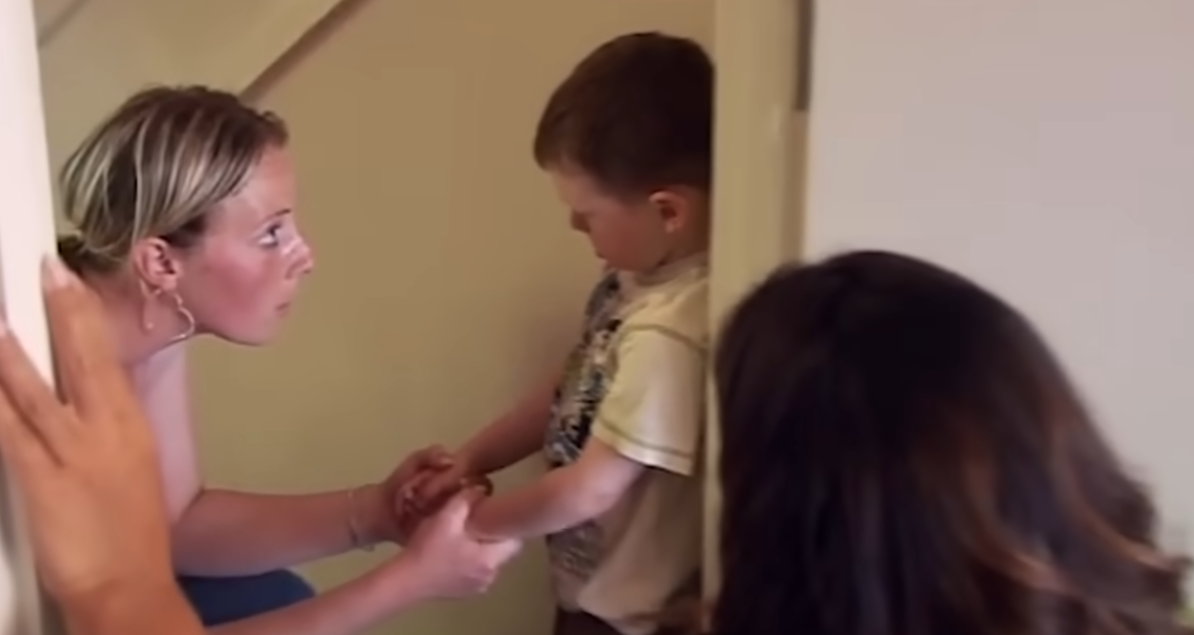
While this scene may seem daunting to some, it highlights a crucial parenting principle: the importance of consistency and maintaining authority. Jo Frost’s technique is not about using harsh punishment or yelling at children. Instead, it is about fostering a calm, controlled environment in which children can learn that aggressive behavior is unacceptable, and that they will not receive attention or reward for acting out. Through her method, Jo teaches that parental authority is not about getting a child to “submit,” but about establishing a clear and consistent structure that children can rely on.
The power struggle between Rhys and his mother in this episode is a familiar scenario for many parents, especially those with young children who are still learning how to navigate their emotions and actions. Aggression, particularly in the form of hitting or biting, is a common behavior in young children, often linked to frustration, anger, or an inability to express emotions effectively. It’s a developmental stage that can cause significant stress for parents, who may not always know the best way to respond.
Jo’s technique, however, emphasizes the importance of staying calm and being firm. She advises parents not to react to the child’s tantrums or use physical punishment, as this can escalate the situation and teach children that aggression is a viable solution to conflict. Instead, Jo encourages parents to stay consistent with their rules and use time-outs as a way to communicate that aggressive behavior is unacceptable. By refusing to engage with the child’s resistance or emotional outbursts, parents can avoid reinforcing the very behavior they’re trying to discourage.
This method not only teaches children about boundaries but also helps them understand that they can trust their parents to maintain those boundaries, even when they act out.
In the case of Rhys, his behavior becomes less about defiance and more about testing limits. He’s not trying to be “bad”—he’s simply exploring the consequences of his actions and seeing how far he can push. For his mother, the challenge is in staying consistent and not giving in to the frustration that naturally arises when a child tests boundaries. It’s not easy. It’s not quick. But the results, as shown in this episode, can be transformative. Rhys eventually learns that his mother will not tolerate physical aggression, and through his apology, he demonstrates that he understands the seriousness of the situation.

The key takeaway from this episode is the role that persistence plays in effective discipline. It is easy for parents to become disheartened when their children do not immediately respond to time-outs or other forms of discipline. But Jo Frost emphasizes that real progress often requires patience and an unwavering commitment to consistency. The “Naughty Corner” technique may seem simple, but its effectiveness lies in the parent’s ability to stay calm and maintain authority in the face of resistance. When children see that their parents are consistent, they begin to understand the value of structure, the importance of respect, and the necessity of appropriate behavior.
Of course, the effectiveness of this method depends largely on the age and temperament of the child. For a four-year-old like Rhys, who is still learning how to navigate his emotions, a simple yet firm consequence like a time-out can be an invaluable tool. However, for older children or children with different emotional needs, other techniques may be more appropriate. Jo Frost’s approach is flexible and adaptable, but it always centers on one crucial element: consistency. Whether a child is four or 14, they need to know that their behavior will have consequences, and those consequences should be applied consistently to avoid confusion or frustration.
Parents who struggle with physical aggression from their children often feel powerless, unsure of how to address the problem without escalating the situation or reinforcing the negative behavior. Jo’s guidance offers a roadmap for parents to regain control in a way that promotes understanding and learning rather than punishment. It’s a strategy that empowers parents to be the calm, consistent authority figure their children need, while also helping children understand the boundaries of acceptable behavior in a supportive environment.
Ultimately, the success of the “Naughty Corner” technique isn’t measured by the child’s immediate compliance, but by the long-term impact on their behavior and emotional development. Through consistent use, children learn that physical aggression will not be tolerated, and that they can expect predictable, fair consequences for their actions. This understanding helps them build trust in their parents and in the world around them, knowing that the adults in their lives will guide them through difficult emotions with love, authority, and patience.
This episode of Supernanny serves as a reminder that parenting is not about control through force, but about control through consistent, compassionate guidance. It is a long process, and it can be emotionally exhausting, but the rewards of teaching children the value of respect, patience, and self-regulation are well worth the effort. For parents struggling with the challenges of aggression and defiance in their children, Jo’s technique offers a beacon of hope: with persistence, calm, and consistency, parents can regain control of their homes and teach their children to navigate the world with kindness and respect.