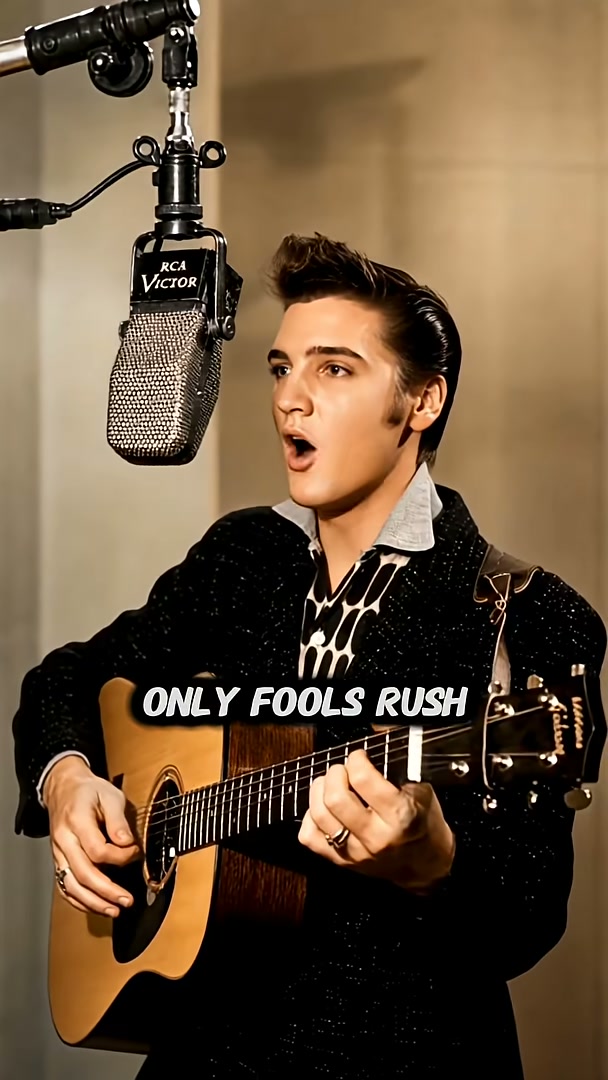
The social-video presentation of “Can’t Help Falling in Love” treats a familiar 1961 recording not as a relic, but as a living romantic language still understood by modern listeners. Framed with lyrics, emojis, and viral-style hashtags, the clip invites viewers to rediscover a song whose power rests on tenderness, restraint, and the quiet certainty of emotional surrender.
At its center is Elvis Presley’s celebrated ballad from the Blue Hawaii soundtrack, a song that has traveled far beyond its original film setting. Written by Hugo Peretti, Luigi Creatore, and George David Weiss, it became one of those rare pop standards that feels both historically specific and strangely timeless.
The presentation does not appear to focus on a live performance or a detailed studio history, but on the emotional reputation the recording has built over decades. Its purpose is more atmospheric than documentary, using the song’s familiar mood to create a short-form experience of nostalgia, romance, and reassurance.
That approach suits the track, because “Can’t Help Falling in Love” has always depended on simplicity rather than spectacle. The melody unfolds gently, the language is direct, and the vocal delivery emphasizes sincerity over ornament, allowing listeners to feel that the song is speaking plainly from the heart.
The lyric’s most memorable image compares love to a river flowing surely to the sea, a metaphor that gives the song much of its enduring emotional force. In that line, affection is not portrayed as a sudden whim or a dramatic conquest, but as something natural, steady, and almost impossible to resist.
This sense of inevitability is one reason the ballad continues to resonate across generations. Many love songs describe desire as a choice or a struggle, but this one frames devotion as a current that carries the speaker forward with calm acceptance.
The video’s nostalgic tone draws attention to that emotional surrender while also placing the song within a contemporary viewing environment. Hashtags, decorative symbols, and romantic captions may seem distant from the early 1960s, yet they show how older music can be repackaged for audiences discovering it through feeds rather than record collections.
That digital framing is not merely cosmetic, because it changes how the song is encountered. A viewer may come across the clip casually, between unrelated posts, and still be pulled into a moment of softness that feels unusually intimate amid the speed of social media.

The mention of Blue Hawaii also matters, because it reminds viewers that the ballad first reached the public as part of a broader entertainment world. Yet the song’s survival has never depended only on the film; it has become independent of its original setting, attached instead to weddings, anniversaries, private memories, and public tributes.
Elvis’s vocal presence is central to that transformation, especially because the performance avoids the swagger often associated with his more energetic recordings. Here, the emphasis is on a controlled, almost hushed delivery that gives the impression of vulnerability without weakening the song’s confidence.
The result is a vocal interpretation that feels intimate even when heard by millions. Rather than pushing for grandeur, the singer allows the melody to carry the emotion, creating a balance between romantic assurance and humble awe.
The social-video format highlights this quality by presenting the song as a “timeless love song,” a phrase often used casually but especially appropriate here. The track has remained relevant not because it explains love in complex terms, but because it captures a feeling many people recognize before they can fully describe it.
There is also a kind of emotional discipline in the song’s construction. Its lines are brief, its images are accessible, and its sentiment is expansive without becoming overly ornate, which makes it easy for listeners to project their own experiences onto it.
That openness helps explain why the song has become a common soundtrack for personal milestones. It can suggest first love, lasting commitment, memory, longing, or reconciliation, depending on the listener’s circumstances and the moment in which it is heard.
The clip’s emphasis on lyrics reinforces the idea that the words remain a major part of the song’s appeal. Even listeners who know only fragments often remember the central phrases, because the writing has the clarity of a simple vow rather than the density of a poetic argument.
At the same time, the song’s continued popularity should not be reduced to sentimentality alone. Its durability also reflects careful craft: a graceful melodic line, a measured arrangement, and a performance that understands the value of leaving emotional space.
The video’s use of “viral” language points to a broader cultural pattern in which classic recordings find renewed visibility through short, shareable posts. Songs from earlier eras can gain fresh attention when paired with mood-based visuals, lyric snippets, or captions that translate their themes into the emotional shorthand of online culture.

This can sometimes flatten music history, but it can also open doors. A viewer drawn in by a romantic clip may become curious about the original recording, the film connection, the writers, and the wider musical world from which the song emerged.
In that sense, the presentation acts as both tribute and invitation. It honors the ballad’s established reputation while giving it a new point of entry for listeners who may not approach it through traditional radio, albums, or classic-film programming.
The romantic branding of the clip is direct, but that directness is part of its appeal. The song itself does not hide behind irony or complexity, and the video’s gentle framing mirrors that straightforward emotional confidence.
Still, the most effective aspect of the presentation is its recognition that the ballad’s power lies in restraint. In a media environment often driven by intensity, speed, and constant novelty, the song offers a slower emotional rhythm that feels almost restorative.
The historical context adds depth without overwhelming the listening experience. Knowing that the track dates to 1961 and is tied to Blue Hawaii situates it within a particular period of pop culture, but the feeling it expresses is broad enough to move beyond that moment.
That combination of period charm and universal sentiment is difficult to manufacture. Many songs are famous in their own time, but fewer become standards that continue to feel personal to people who were born long after their release.
The video understands this continuing relevance by presenting the song less as an artifact than as a companion to modern emotion. Its message is that certain recordings endure because they give listeners a graceful way to name feelings they already carry.
As a piece of social-media music culture, the clip is simple, sentimental, and deliberately accessible. As a tribute to a classic ballad, it succeeds by foregrounding the qualities that made the recording last: lyrical clarity, melodic calm, and a voice that treats love as both fragile and certain.
Ultimately, “Can’t Help Falling in Love” remains powerful because it turns inevitability into comfort. The video’s nostalgic digital framing may be contemporary, but the feeling it celebrates is the same one that has carried the song for more than six decades.