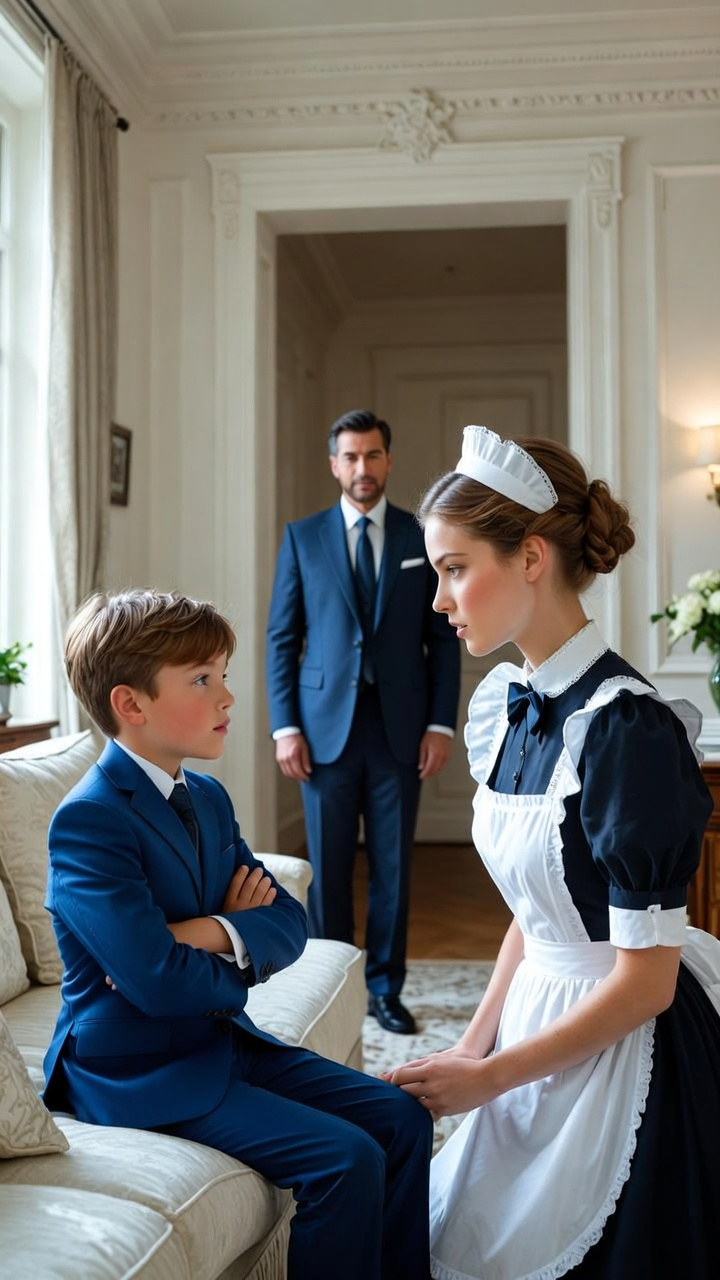
The Whitmore mansion in Beverly Hills was the sort of place magazines liked to photograph from the air. From above, it looked less like a home than a private kingdom—white stone terraces, a pool so still it resembled glass, high windows reflecting the California sun as if the entire estate had been polished into perfection.
At night, the lights along the driveway glowed like a path designed for arriving success. In the mornings, the fountains whispered over imported marble. Inside, every room held evidence of wealth so absolute it had stopped trying to impress anyone.
And yet the house had fallen silent in a way no architect could have anticipated.
Not peaceful silence. Not the kind that belongs to luxury.
This was the kind of silence that settled into the walls and remained there, pressing itself into doorframes, carpets, chandeliers, and the air itself, until every person inside the house began to move more carefully, speak more softly, breathe more lightly, as though any sudden sound might crack something already fragile.
For Daniel Whitmore, that silence had become the defining sound of his life.
Two years earlier, the mansion had still felt alive. His wife Olivia’s laughter had once traveled easily through the corridors, warm and bright enough to make even the most formal room feel human. Their son Ethan had followed her everywhere, a lively little shadow with restless eyes and endless questions.
The housekeeper used to complain, only half-seriously, that the child never stopped talking. Daniel used to smile at that. At the time, he could not have imagined a world in which he would beg—desperately, helplessly—just to hear his son speak one more time.
But then Olivia had disappeared.
One day she had simply ceased to exist in the life of the house. No argument. No explanation Daniel could touch. Only a story handed to him by his father, Richard Whitmore Sr., with the authority of a man accustomed to being believed: Olivia had left. She had run away with another man. She had chosen freedom over motherhood, selfishness over family, and had done it quietly because, according to Richard, shame usually preferred silence.
Daniel had not wanted to believe it.
But grief, when mixed with pride and shock, can make lies feel easier to live with than uncertainty. He had accepted the version that hurt less in the short term and destroyed more in the long one.
Ethan had not accepted anything.
At five years old, he had waited for his mother at first with the unwavering certainty children possess. He sat near the front windows. He watched the driveway. He slept with a worn teddy bear pressed against his chest and asked every day when she would come home.
Then one day, he stopped asking.
Soon after that, he stopped speaking entirely.

No doctor had been able to reverse it. Therapists called it trauma-induced mutism. Specialists used gentler language, but every explanation came down to the same unbearable truth: Ethan had not lost the ability to speak. He had buried it somewhere so deep that no one could reach it.
Daniel hired expert after expert. Twenty-three caregivers came and went through the mansion in two years. Some were patient. Some were overly cheerful. Some were coldly professional. A few tried too hard, which was its own kind of failure. Ethan looked through all of them as if they were shadows moving across a wall.
Each time one left, the house grew a little quieter.
By the time the twenty-fourth arrived, Daniel had almost stopped believing anyone could help.
Her name was Isabella Cruz.
She appeared at the front door late in the afternoon, when the California light had turned gold and thin, spreading across the foyer in long bands that made the marble glow softly underfoot. Daniel himself opened the door. He had not meant to. Usually someone else handled these things. But the house had become a place where he trusted fewer and fewer people with anything.
The woman standing on the threshold looked younger than he expected—perhaps twenty-eight. Her uniform was neat, almost severe in its simplicity, but over one shoulder she wore a soft shawl that partly covered the right side of her face.
The detail was unusual enough that Daniel noticed it immediately, though not enough that he commented on it. There was something in her posture that discouraged careless questions. She stood calmly, not like someone begging for a position in a billionaire’s household, but like someone who had already decided why she was there.
“Mr. Whitmore,” she said in a voice that was low, steady, and unexpectedly warm, “I have experience with children who’ve gone through deep trauma.”
Most applicants said more than that. They listed credentials, institutions, references, methods. Isabella simply stood there with the composure of someone who understood that pain rarely responds to speeches.
Daniel studied her for a moment longer than was polite. He wanted to ask about the shawl. About her face. About why she seemed less eager than anyone else who had stood in that doorway before. Instead, he stepped aside and let her in.
That same afternoon, Isabella went to Ethan’s room.
Daniel did not follow, though he remained just beyond the half-open door for several seconds, unable to leave entirely. Ethan sat, as he often did, in the far corner near the window, knees drawn up, teddy bear in his arms, his gaze fixed on something distant and invisible.
The room itself was beautiful in the curated, expensive way children’s rooms often are in wealthy homes—hand-painted walls, custom shelves, soft rugs imported from Europe—but none of it had warmth. It looked like a room built by designers, not by memory.
Isabella did not cross the room too quickly. She did not call Ethan’s name in a falsely cheerful voice. She did not kneel in front of him or reach for him or clutter the silence with strategies. Instead, she sat down on the floor a safe distance away and simply remained there.
Then, after a long, quiet moment, she began to hum.
The melody was old. Daniel recognized it not by title but by feeling. It was the kind of lullaby that seemed to come from before memory, something soft and circular and familiar enough to lower a guard without asking permission. Ethan’s eyes shifted. It was slight—so slight another person might not have noticed—but Daniel saw it. His son was listening.
Isabella kept humming.
Slowly, Ethan looked up.
The moment was so small it would have seemed meaningless to anyone who didn’t live in that house. But to Daniel, who had spent two years measuring hope in fractions, it felt enormous.
Later, when Isabella rose to straighten the room, she noticed a stack of drawings half-hidden beneath the bed. She pulled one gently into the light. It was a child’s drawing of a family—father, mother, son—done in uneven crayon lines. The mother’s figure had been crossed out so aggressively the paper had nearly torn.
“That’s a beautiful family,” Isabella said softly, as if speaking not to the room but to the ache inside it. “Do you miss her?”
Daniel felt his chest tighten. The question should have been dangerous. Too direct. Too soon.
Ethan did not speak.
But for the first time in two years, he nodded.

A single tear rolled down his cheek.
Isabella did not react dramatically. She did not praise him or make the moment heavier with surprise. She only extended her hand, palm open and still.
“I’m going to take care of you,” she said quietly. “I promise.”
After a long hesitation, Ethan reached out and touched her fingertips.
That night, Daniel stood alone in his study for a long time, staring out over the dark lawn, replaying the scene in his mind. He did not know why it unsettled him so deeply. Perhaps because Isabella had done in one hour what twenty-three people had failed to do in two years. Or perhaps because she moved through the house with a familiarity she should not have had—as if she understood not only Ethan’s pain, but its shape.
The next morning, the first thing she did was go to the kitchen.
Mrs. Thompson, the longtime housekeeper, had spent fifteen years with the Whitmores and had reached the age where loyalty and caution had become nearly indistinguishable. She was kind, efficient, and careful in all the ways servants in old money households learn to be. When Isabella entered and began preparing breakfast, Mrs. Thompson watched her with polite suspicion.
Yet what Isabella made was not random.
Warm vanilla oatmeal.
And a chocolate pastry, cut precisely into four pieces.
It was, as Daniel discovered when he entered the breakfast room a few minutes later, exactly the breakfast Ethan had loved before Olivia disappeared.
He stopped in the doorway.
Ethan was eating.
Not reluctantly. Not because someone had begged him to take one more bite. He was eating with appetite, with recognition, with the simple, almost forgotten pleasure of a child tasting something tied to love.
Daniel looked at Isabella. She did not explain.
Some instincts are too exact to be accidental, he thought. But he said nothing.
By late afternoon, Isabella had accomplished what no one else in the house seemed able to do: she had gained Mrs. Thompson’s trust. It happened not through charm, but through patience. A cup of tea. A quiet question asked at the right moment. A silence that invited truth rather than cornered it.
“Mrs. Thompson,” Isabella said softly in the laundry room, where the hum of machines covered conversation better than walls did, “what really happened to Mrs. Olivia?”
The older woman’s hands paused over a folded towel.
For a moment she said nothing. Then she glanced toward the doorway, as though fear had memory enough to stand guard even after two years.
“Ethan’s grandfather hated her,” she whispered at last. “From the beginning. Said she wasn’t worthy of the family. Said she married Daniel for the money.” Mrs. Thompson swallowed. “One night, she was just… gone. Mr. Whitmore’s father told Daniel she ran off.”
Isabella didn’t move.
“You don’t believe that,” she said.
Mrs. Thompson lowered her eyes. “I never did.”
Suspicion, once given shape, becomes difficult to contain. That evening Isabella asked to see the attic, the part of the mansion where old things were sent when the family wished to live without looking directly at them. Dust floated in the slanted light from the small windows overhead. Boxes were stacked in careful disorder. Dresses that no one wore anymore hung beside framed photographs turned backward against the wall. It smelled of cedar, old fabric, and abandonment.
Among Olivia’s stored belongings—a handbag, perfume bottles, winter scarves, several books with pressed flowers between their pages—Isabella found an envelope tucked into the lining of a worn bag.
It was sealed.
Her hands shook as she opened it.
Inside was a handwritten letter dated one week before Olivia’s disappearance.
My beloved Ethan, it began.
If you are reading this, it means bad people forced me to leave to protect you. I would never abandon you. Keep your teddy bear—it will be my hug until I find a way back.
By the time Isabella finished reading, tears had blurred the page.
Olivia had not left.
She had been made to disappear.
Once that truth existed, the rest moved quickly. Through an old contact, Isabella traced Olivia to a small café at the edge of the city. The woman she found there was thinner than the photographs, older in the eyes, but unmistakably the same. Olivia listened to Isabella in stunned silence, one hand gripping the edge of a table so hard her knuckles turned white.
When she finally spoke, the truth came out in pieces sharp enough to wound.
Richard Whitmore Sr. had fabricated fraud accusations against her. He had threatened to ruin her completely, to have Ethan sent away to boarding school overseas, to bury her under enough legal ruin that she would never see her son again—unless she disappeared on her own and did it permanently.
So she had left.
Not because she wanted to.
Because she believed it was the only way to protect Ethan.
Isabella returned to the mansion with a plan. She had the letter. She had Olivia. She had enough truth now to begin breaking the lie apart.
But when she entered the living room, everything stopped.
Daniel stood in the center of the room, rigid with fury. Beside him sat Richard Whitmore Sr., elegant despite age, one hand resting on his cane, his face arranged into a cold smile that never reached his eyes. On the opposite sofa sat a stranger holding a folder of photographs.
“This,” Richard said, tapping the marble floor once with his cane, “is the impostor.”
Daniel turned toward Isabella, and the hurt in his face was worse than anger.
“My father just brought me proof,” he said. “You’re not a caregiver. This woman is the real Isabella Cruz. You stole her identity. Who are you?”
For one suspended second, the air in the room seemed to vanish.
Then Isabella inhaled slowly and removed the shawl from her face.
A burn scar ran along the right side—old, pale, unmistakable.
“Don’t call the police,” she said. Her voice did not shake. “Daniel… look at me. Really look at me. It’s been fifteen years. Since the accident at your grandmother’s house.”
His expression changed.
Confusion first.
Then recognition.
“Valerie?” he whispered. “You’re Valerie… Olivia’s cousin?”
“Yes.”
The room seemed to shift under the force of that truth alone.
“I’m Ethan’s godmother,” she said. “And I came here because everything you were told was a lie.”
Before Daniel could answer, another voice cut across the room like glass breaking.
“Mom didn’t leave us!”
Everyone turned.
Ethan stood at the top of the staircase, trembling, tears running down his face.
For two years he had spoken nothing.
Now his voice came all at once—raw, cracked, unstoppable.
“He’s lying!” Ethan screamed, pointing at his grandfather. “Grandpa is bad!”
Richard Whitmore Sr. actually recoiled, if only by an inch.
Ethan ran down the stairs clutching his teddy bear so tightly its old fur was flattened under his fingers. From inside it—hidden in a seam only a child would keep sacred—he pulled the letter.
“Look, Dad!” he cried. “Mom wrote this! She loves us!”
Daniel took the paper as though it might burn him.
He read.
And with each line, something in him collapsed.
The story he had lived inside for two years shattered under the weight of ink written in Olivia’s hand.
When he looked up, his face no longer held confusion. Only devastation.
“Tell me this isn’t true,” he said to his father, his voice so cold it barely sounded human.
Richard did not deny it.
His chin lifted instead, the old arrogance hardening into contempt.
“I did it for this family,” he snapped. “She was nothing. A distraction. A weakness.”
Daniel stared at him for a long moment. Then he spoke with the steadiness of a man stepping into a grief too large to postpone any longer.
“I will never forgive you.”
Richard’s eyes narrowed.
“You think you can speak to me that way in my family’s house?”
“This is my house,” Daniel said. “And you are leaving it now.”
No one moved.
Then Daniel took one step toward him, and the authority in him—the real authority, stripped of inheritance and fear—filled the room.
“You’re out of the company. Out of this house. And if I find the proof I need, you’ll lose more than that.”
For the first time, Richard looked old.
Valerie was already dialing a number.
When Olivia answered, she didn’t have time to say hello.
“Mom!” Ethan cried into the phone. His entire body shook with the force of the word. “It’s me! I can talk now!”
On the other end of the line, Olivia began to sob.
“I’m coming home,” she said.
The hour that followed felt unreal, as though the house itself had stopped knowing what time was. Daniel knelt before Ethan and held him, crying openly now, no longer trying to protect dignity that had already cost too much. Valerie remained near them, calm but pale, as if years of waiting had narrowed into this one impossible evening.
When the door finally opened, Olivia entered not with drama but with desperation. She saw Ethan. Ethan saw her. Then there was no room left for anything else.
He ran.
She ran.
They collided in each other’s arms with the force of two years breaking all at once.
Daniel joined them a moment later, his apologies incoherent and endless, buried between tears and the names he had not allowed himself to hope would ever be spoken together again.
For the first time in two years, the family was whole.
Not healed. Not yet. Healing is slower than revelation.
But whole.