
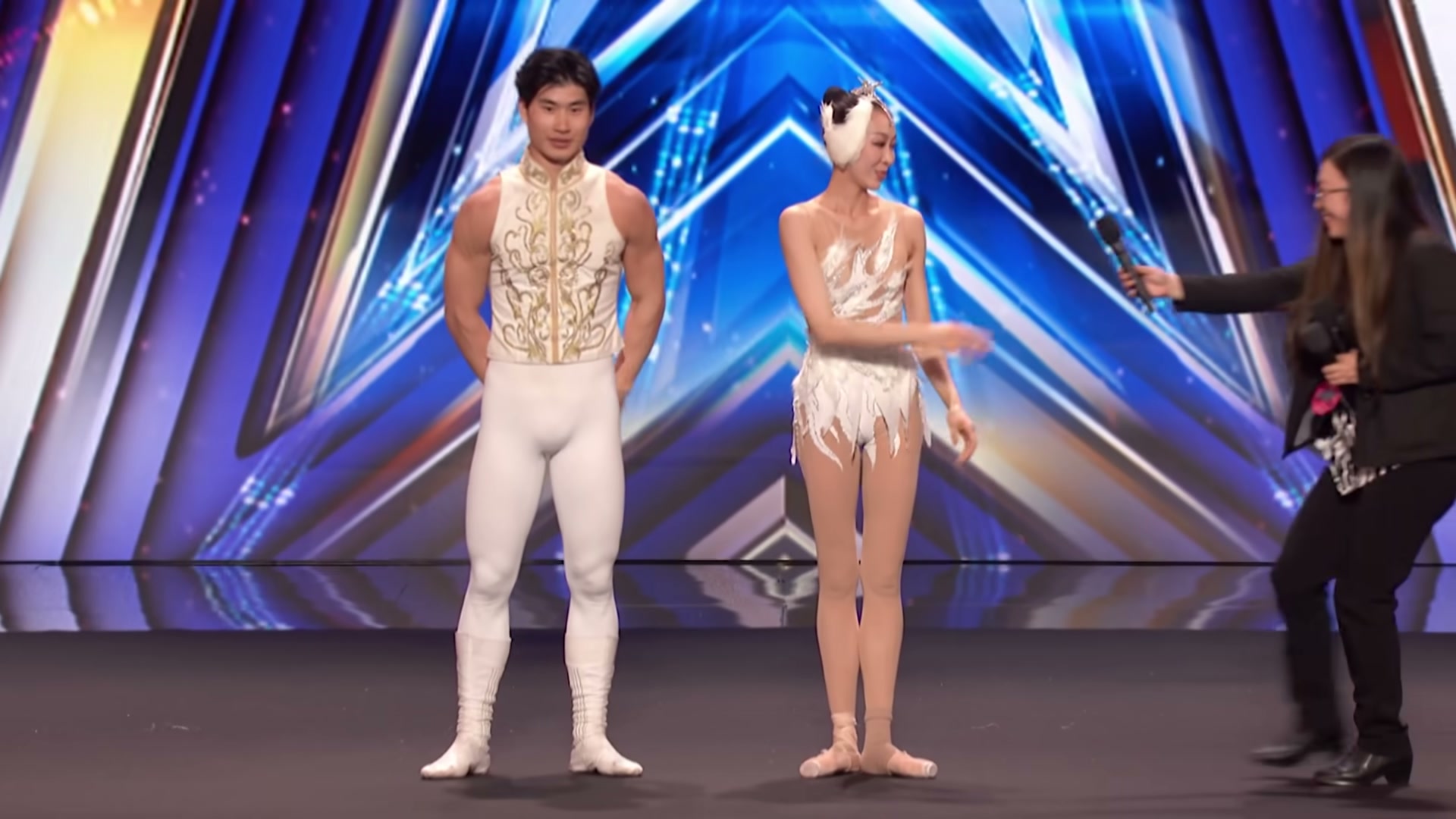
America’s Got Talent has built much of its reputation on acts that make familiar forms feel newly dangerous, and Xi’an Acrobatic Troupe arrived with exactly that kind of promise. Their appearance in the 2025 season introduced a style described as “ballet on shoulder,” a hybrid of classical dance, acrobatic partnering, and extreme balance.
At first glance, the act seemed rooted in the grace and restraint of ballet, with elegant lines, measured movement, and a calm stage presence. Within moments, however, the routine shifted into something far more precarious, as the female performer rose above her partner and began balancing en pointe on his body.
The central image of the performance was both delicate and startling: a ballerina poised on the shoulders and head of her partner while maintaining the precision expected from classical technique. That contrast between fragility and strength became the act’s defining feature, turning every slow movement into a moment of suspense.
Unlike many danger acts that rely on speed, noise, or shock, this routine drew tension from control. The performers moved with quiet confidence, making the difficulty feel almost invisible until the audience registered just how little margin for error existed.
The male performer served as a living platform, using strength and stillness to create the base for movements that would be difficult even on a flat stage. The female performer, meanwhile, had to preserve ballet’s visual softness while balancing on surfaces no dancer would normally use for pointe work.
That dual demand gave the act its emotional pull, because it asked viewers to admire beauty and worry about risk at the same time. Each pose carried the polish of a dance performance and the stakes of an acrobatic feat, creating a combination that felt unusually fresh for the talent show stage.
The judges’ reactions reflected that sense of surprise, especially because the routine did not fit neatly into one familiar category. It was not simply ballet, not simply balancing, and not simply a circus-style stunt, but a carefully composed blend of all three.
Howie Mandel highlighted the rarity of what the panel had just seen, saying that in 20 years on the show he had never watched anything quite like it. He also thanked the performers for traveling from China, framing their appearance as a reminder of how international the show’s stage has become.
Sofía Vergara responded to the visual beauty of the act and the spectacle created by its physical difficulty. She described the performance as mesmerizing and suggested it belonged on the biggest stages in the world, praise that matched the audience’s enthusiastic response.
Simon Cowell focused on how the act changed his expectations of ballet, a form he admitted he can sometimes find boring. In his view, the troupe had made ballet interesting for a broader audience by transforming it into something unexpected, theatrical, and impossible to ignore.
His description of the routine as “ballet on shoulder” captured both its simplicity and its strangeness. The phrase sounded almost casual, but the performance behind it required years of training, trust, and exact coordination between two artists whose timing had to be flawless.
The act also stood out because it avoided overcomplication. Rather than filling the stage with distractions, the troupe placed the focus on bodies, balance, and the clean visual drama of one performer elevated by another.

That restraint helped the danger feel more intense, because there was nowhere for mistakes to hide. Every adjustment of posture, every transition, and every held position became part of the story the performers were telling.
The routine’s success depended heavily on trust, a quality that could be felt even without explanation. The female dancer’s calm expression and controlled pointe work were possible only because her partner remained steady beneath her, while his strength mattered because she matched it with precision.
Together, they created a stage picture that seemed to suspend gravity rather than defy it through brute force. The best moments did not shout for applause, but invited the audience to hold its breath and then release it when the pose resolved.
For a show that has seen countless singers, dancers, magicians, and acrobats, originality can be difficult to achieve. Xi’an Acrobatic Troupe found it by taking an art form many viewers recognize and placing it in a context where every familiar movement carried a new kind of risk.
That reinvention is what made the performance more than a display of physical skill. It suggested that ballet, when combined with acrobatic tradition and theatrical imagination, can still surprise audiences who think they know what it looks like.
The unanimous yes votes were not surprising after the room’s reaction. The judges praised the act’s originality, beauty, and stage potential, while the audience responded to both the elegance of the presentation and the danger built into its design.
By the end, the duo had turned a simple question into a memorable answer: what happens when pointe work leaves the floor entirely. On AGT’s 2025 stage, Xi’an Acrobatic Troupe showed that grace can be thrilling, strength can be beautiful, and balance can become a form of storytelling.