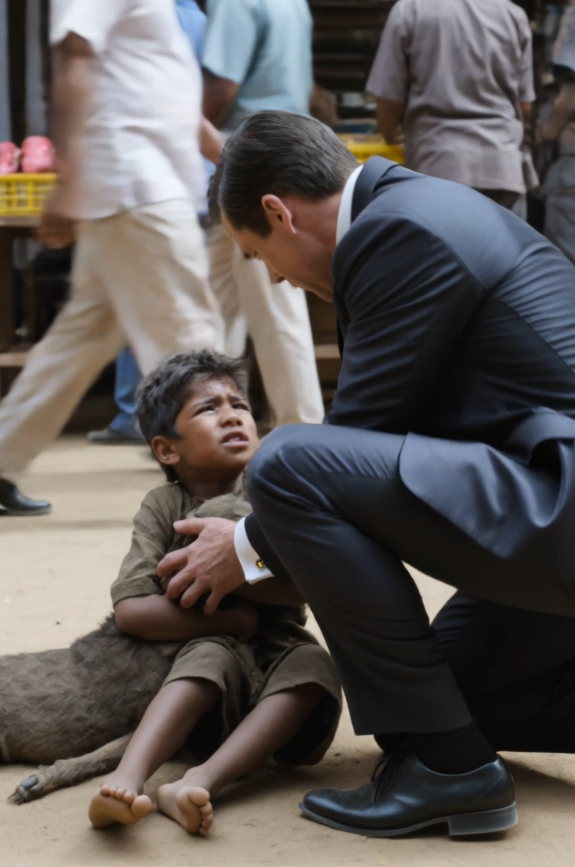
There are meetings that begin with blood rather than recognition. On a crowded morning in the old market, a billionaire in a pressed coat and a boy with dust on his bare feet knelt beside the same dying dog. One had money, the other only stubbornness. Neither knew, in that first bewildering moment, that the same impatience, the same eyes, and the same scar at the chin had already bound them long before truth arrived.
Theo Mercer disliked markets.
They were loud in the wrong way—too close, too human, too full of the unprofitable details wealth exists partly to filter out. But a redevelopment meeting near the river district had run longer than expected, and traffic forced his car into a neighborhood he usually saw only from tinted glass.
He might have remained sealed inside that comfortable distance if not for the sharp barking that cut through the horns and vendor calls and made his driver brake abruptly.
A dog had been struck by a motorcycle.
It lay near the fruit stalls, whimpering weakly, one hind leg twisted at an angle that made onlookers wince and then, as onlookers often do, keep moving. Before Theo could tell the driver to go around, a boy darted into the road with the urgency of someone who had not yet learned the world punishes such impulses.
Thin, dark-haired, perhaps ten years old, he dropped to his knees beside the animal and began shouting at adults twice his size for cloth, water, help—anything.
Theo got out of the car before asking himself why.
“Don’t touch him there!” the boy snapped immediately, not even glancing up. “You’ll scare him.”
Theo, who had not taken instructions in years from anyone without a board title, stared in astonishment.
The boy finally looked up.
For a second both of them froze.
The resemblance was not obvious enough to announce itself dramatically, but it was there in the angles—the strong brow line, the set of the mouth when concentrating, the small pale scar at the chin that Theo himself carried from a childhood fall off a stable fence. Impossible, of course. Yet the sight unsettled him enough that he obeyed rather than argued.

Together they wrapped the dog in a feed sack and carried it to Theo’s car. The boy insisted on coming to the veterinary clinic, then spent the entire ride with one hand on the animal’s head, murmuring nonsense comfort under his breath. When Theo asked his name, he answered without self-pity, “Noah.” When asked about his family, he said, “Just my mother. She’s at the laundry.”
The clinic saved the dog.
Theo should have sent the child home with money and forgotten the incident. Instead he bought Noah lunch, partly because the boy was clearly hungry and partly because something in Theo, old and long sealed, had begun to itch uncomfortably.
Over soup and bread Noah spoke little but watched everything. His manners were rough, his intelligence impossible to miss. He cut his food into equal portions and quietly wrapped half in a napkin.
“For later?” Theo asked.
“For my mother,” Noah said.
It was the sort of answer that undoes people when they are least prepared.
The mother arrived before the meal ended, breathless from running, apron still dusted with starch from the laundry. She stopped in the restaurant doorway, saw Theo, and went so white he knew instantly that whatever strangeness he had felt since the market had not been one-sided.
Her name was Elara.
Once, nearly eleven years earlier, she had been a junior architect on a resort project Theo financed before his family steered him into an engagement more suitable to the press and the board. There had been a brief affair—brief enough to be denied, intense enough not to be forgotten.
When she became pregnant, she tried to reach him. His father’s office intercepted the letters. The settlement offer sent in response never reached her intact. By the time Theo learned, if he had learned, the story had already been rewritten in the efficient silence of powerful families.
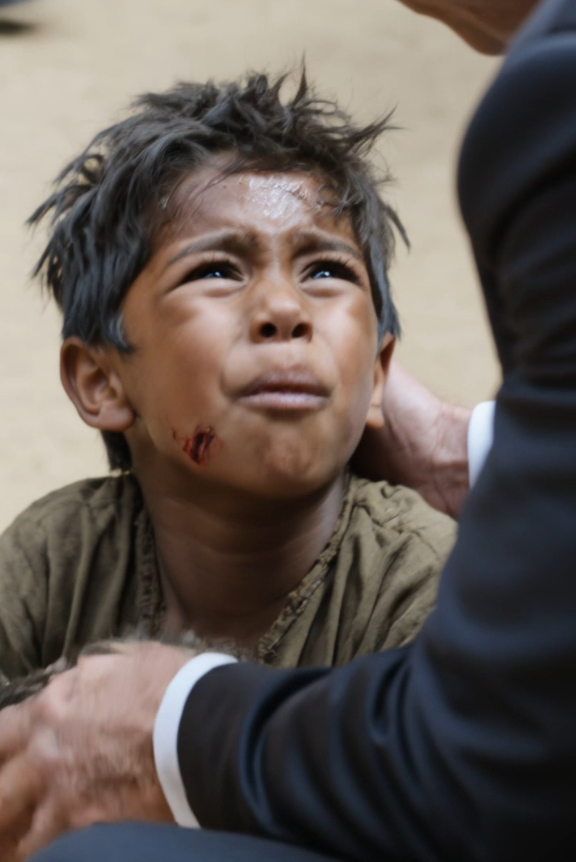
Noah sat between them, unaware of the history detonating across the table.
“You knew,” Theo said quietly after the first stunned minutes.
Elara lifted her chin despite the trembling in it. “I knew you would never have been allowed to keep us.”
The cruelty of that sentence was not directed at him alone.
DNA made truth official, but Theo recognized his son before paper ever could—in the boy’s refusal to look away from suffering, in the quick fierce intelligence, in the infuriating habit of arguing from moral certainty. By the fourth day Noah had already asked him, “If you’re really my father, why didn’t you come?” and there was no answer sufficient for a ten-year absence built from lies, class, fear, and other people’s decisions.
So Theo answered with the only honesty left.
“Because I didn’t know in time,” he said. “And because knowing now does not erase what you lived without.”
Noah held his gaze for a long moment, then nodded once, like someone filing pain carefully away for later examination.
Outside the clinic window the recovered dog barked from a kennel, alive because a barefoot boy had refused indifference.
And Theo, who had spent years building towers high enough to keep the world manageable, found himself sitting in a plastic chair beside a child who had already shattered every structure in him that deserved to break.