The recurring prank built around George Clooney’s proximity to Ellen DeGeneres’ studio works because it treats a simple coincidence like a major breaking story. What begins as a neighborly observation becomes a full comic campaign, complete with fake surveillance, dramatic narration, celebrity accomplices, and increasingly silly attempts to make him step outside.
The premise is immediately clear and easy for the audience to enjoy: a famous movie star is supposedly working next door, and Ellen decides that this must not go unexploited. Rather than presenting the situation as a casual studio anecdote, she transforms it into “George Watch ’08,” a mock investigation that gives every small movement outside his office the importance of live news coverage.
The humor depends heavily on exaggeration, especially Ellen’s ability to act both thrilled and suspicious at the same time. She frames the camera pointed toward Clooney’s bungalow as if it were a legitimate reporting tool, then reacts to ordinary moments with the intensity of someone uncovering a scandal.
One of the earliest bits centers on footage of Clooney emerging from his office area and interacting with an orchid, which Ellen treats as evidence of highly questionable behavior. The joke is not that anything dramatic has happened, but that she narrates the flower’s movement as if it were a mystery worthy of public concern.
That orchid becomes a surprisingly effective prop because it gives the prank a physical object to return to. Ellen’s mock outrage over whether the plant has been taken, replaced, or otherwise tampered with lets her create a story line where there would otherwise only be a celebrity walking near a door.
Her response also reveals the playful possessiveness that fuels the entire running gag. She jokes about reclaiming the orchid and finding a prominent place for it, even suggesting it could be displayed near her awards, turning a small office decoration into a trophy of comic victory.
The audience’s reaction is essential to the rhythm of these segments. Each time footage appears, or Ellen announces a new development, the crowd responds with cheers, applause, and laughter, reinforcing the sense that everyone is participating in a harmless, ongoing neighborhood operation.
Ellen’s performance style keeps the joke from becoming too aggressive. She plays the situation with deadpan seriousness, but the absurdity is always obvious, and the target remains less a victim than a glamorous offscreen presence whose absence becomes the central punchline.
As the bit develops, Ellen stops relying only on the hidden camera idea and begins physically moving toward Clooney’s office. This shift gives the prank new energy, because the comedy expands from commentary behind a desk to staged expeditions outside, where anything might be left at his door.
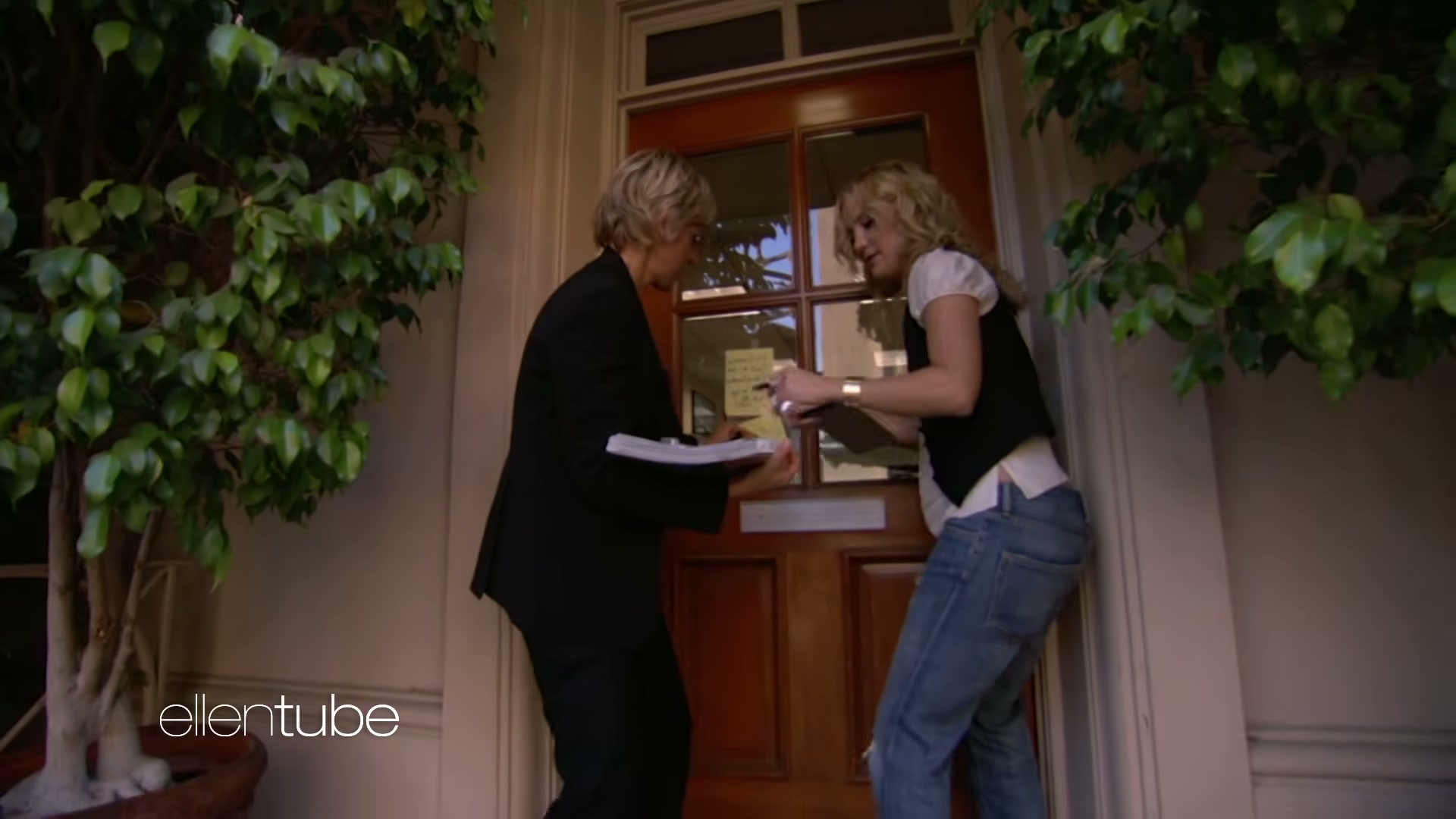
The involvement of Kate Hudson adds a new layer because the prank becomes less private and more like a celebrity team effort. Together, Ellen and Hudson leave items such as magazines, music, and a phone number as bait, turning the hallway outside Clooney’s office into a playful trap designed to lure him into view.
That sequence works because it mixes childish mischief with the polished atmosphere of a talk show. The props are harmless and ordinary, but the way they are presented makes them feel like carefully selected tools in a ridiculous mission to attract the attention of an elusive neighbor.

Hudson’s presence also changes the emotional texture of the prank. Instead of Ellen simply obsessing from afar, the scene becomes a shared game, and the audience gets to watch another guest willingly enter the fantasy that Clooney’s door is the center of the entertainment universe.
Dolly Parton’s participation pushes the gag even further into variety-show territory. Her appearance brings warmth, showmanship, and a heightened sense of theatricality, which fits perfectly with a prank that has already abandoned realism in favor of cheerful escalation.
With Parton involved, the joke becomes less about whether Clooney will actually appear and more about how far the show can stretch the premise. The celebrity ambush atmosphere allows for oversized props, flirtatious teasing, and a kind of old-fashioned stage comedy where the anticipation matters as much as the payoff.
The later escalation involving beauty queens, including the punning figure of “Miss Georgia Clooney,” shows how fully the show commits to the bit. By that point, the prank has become a miniature pageant of absurd solutions, all designed around the same impossible goal of drawing one famous neighbor out of hiding.
That escalation is important because running jokes need variation to survive. Each new attempt has to feel connected to the original premise while still adding a fresh angle, and the show accomplishes this by changing the participants, props, and scale of the ambush.
The structure resembles a comic snowball, beginning with one camera and one flower before gathering more guests and more elaborate set pieces. The audience can follow the progression easily, because every new stunt is just another answer to the same question: what could possibly make him come outside?
Clooney’s limited visibility actually strengthens the comedy. Because he appears only briefly or remains just beyond reach, he becomes almost mythic within the bit, a neighboring celebrity whose ordinary schedule is treated like a rare wildlife sighting.
That distance also keeps the joke balanced. The show never needs to corner him for the segments to work, because the fun lies in Ellen’s exaggerated planning, the audience’s anticipation, and the gap between the grand setup and the simple reality of office life.
Ellen’s mock surveillance language is especially effective because it parodies the seriousness of media coverage. By labeling the segment “George Watch,” she borrows the urgency of news alerts and applies it to a harmless studio neighbor situation, which makes the format itself part of the joke.
At the same time, the humor reflects a broader talk-show tradition of blurring the line between backstage access and performance. Viewers are invited to feel as if they are peeking behind the curtain, even though the entire scenario is carefully shaped for entertainment.
The prank also succeeds because it understands celebrity culture without becoming mean-spirited about it. Clooney’s fame is the engine of the joke, but the segments focus more on Ellen’s exaggerated fascination and the show’s theatrical response than on mocking him personally.

That distinction matters in keeping the tone light. The comedy is built around admiration, curiosity, and staged inconvenience, not humiliation, and the recurring cheers suggest that the audience reads it as affectionate rather than hostile.
The guests who join the prank help preserve that mood. Hudson and Parton are not there to intensify conflict; they are there to play along, embellish the fantasy, and make the entire situation feel like a friendly conspiracy shared among performers and viewers.
The use of props reinforces the playful tone as well. An orchid, magazines, an iPod, a phone number, and pageant-style signage are all comic objects rather than threatening devices, which keeps the ambush safely in the realm of sketch-like silliness.
What makes the recurring bit memorable is its confidence in a very small premise. Many shows might have mentioned a famous neighbor once, but Ellen’s team turns the idea into a continuing series by treating every non-event as a development worth revisiting.
That commitment allows the audience to anticipate the pattern. Once viewers understand the rules of the game, they can enjoy the smallest changes, whether Ellen is reacting to footage, heading outside, recruiting a guest, or unveiling a new lure.
The segments also demonstrate how a daytime talk show can create comedy from its own geography. The fact that Clooney’s office is nearby becomes part of the studio’s mythology, making the physical space outside Ellen’s stage feel like an extension of the show.
In that sense, the prank is not only about one celebrity neighbor. It is about turning the ordinary environment of production into a playground, where hallways, doors, flowers, and waiting areas can become pieces of a larger comic story.
The running gag’s emotional arc is deliberately simple but effective. It moves from discovery to suspicion, from suspicion to investigation, and from investigation to an increasingly absurd campaign of attraction, all while maintaining an atmosphere of cheerful impatience.
The audience is rewarded not with a major confrontation, but with the pleasure of escalation. Each new attempt is funny because it shows how disproportionate the response has become compared with the original situation.
By revisiting these moments together, the video highlights how well the prank format suited Ellen’s strengths as a host. Her timing, calm delivery, and willingness to look ridiculous allow the joke to grow without needing complicated explanations or harsh punchlines.
Ultimately, the appeal of the recurring bit lies in its blend of celebrity proximity and everyday silliness. A famous neighbor, a watched doorway, a disputed orchid, and a parade of willing accomplices become enough to sustain a warm, ridiculous, and audience-friendly comedy saga.