
America’s Got Talent marked its 20th season with a performance that felt less like a standard audition and more like a preview of entertainment’s next frontier. Boston Dynamics brought five four-legged robots to the stage for a synchronized routine to Queen’s “Don’t Stop Me Now,” turning a familiar talent-show setup into a surreal mix of engineering, comedy, and spectacle.
The act arrived with instant curiosity because it did not fit the usual categories of singers, dancers, magicians, or stunt performers. Instead, the stage filled with machines built for mobility and precision, moving in formation while judges and audience members tried to decide whether they were watching a dance number, a product demo, or science fiction becoming live variety entertainment.
The routine began with upbeat party energy, helped by a song famous for momentum and theatrical confidence. As the robots stepped, turned, and coordinated their movements, the appeal came from how mechanical timing could still create something playful and strangely charming.
That charm was paired with obvious tension, because every movement depended on complex robotics working under live-show pressure. Unlike human performers, these machines could not smile through nerves or improvise with facial expression, so every clean step carried a different kind of drama.
Then came the moment that made the audition memorable beyond its novelty. One robot appeared to malfunction or collapse during the performance, interrupting the polished rhythm and creating a tense, funny, and oddly human break in the routine.
For a few seconds, the room seemed unsure how to react. Concern, laughter, surprise, and fascination all overlapped as the remaining robots continued the number, making the fallen machine part of the story rather than a reason to stop.
That unexpected failure gave the act a strange advantage. Simon Cowell suggested the mishap made the performance “weirdly better,” because it revealed the challenge behind the showmanship and made the audience understand that this was not a simple button-press demonstration.

The comment captured why the audition worked as television. A flawless routine might have looked impressive but distant, while the breakdown made the stakes visible and gave the judges a moment of suspense they could read in real time.
Boston Dynamics also leaned into the mishap instead of pretending it had not happened. The team summed up its philosophy with the motto “Build it.
Break it. Fix it,” framing failure as part of invention rather than embarrassment.
That attitude matched the company’s reputation for pushing machines into complicated movement tasks, where balance, timing, and recovery matter as much as design. On the AGT stage, that engineering mindset translated into entertainment because viewers could see both the ambition and the risk.
The judges responded with a combination of amazement and nervous amusement. Howie Mandel, Sofía Vergara, Mel B, and Simon Cowell all treated the act as something different from the show’s usual auditions, with reactions that suggested wonder as much as judgment.
Part of the fascination came from watching machines perform in a setting built around personality. AGT usually rewards emotion, charisma, danger, and originality, and this act found a way to touch all four without using a traditional human star at center stage.
The robots had no expressions, but the performance still created character through timing and contrast. Their formation work looked precise, their song choice gave them a playful mood, and the collapse supplied the kind of unscripted twist that live variety shows often depend on.
Host Terry Crews and the audience helped sell the moment by reacting with open surprise. The room’s laughter did not feel like mockery, but like the release of tension after seeing technology wobble in a place where everyone expected either perfection or total failure.
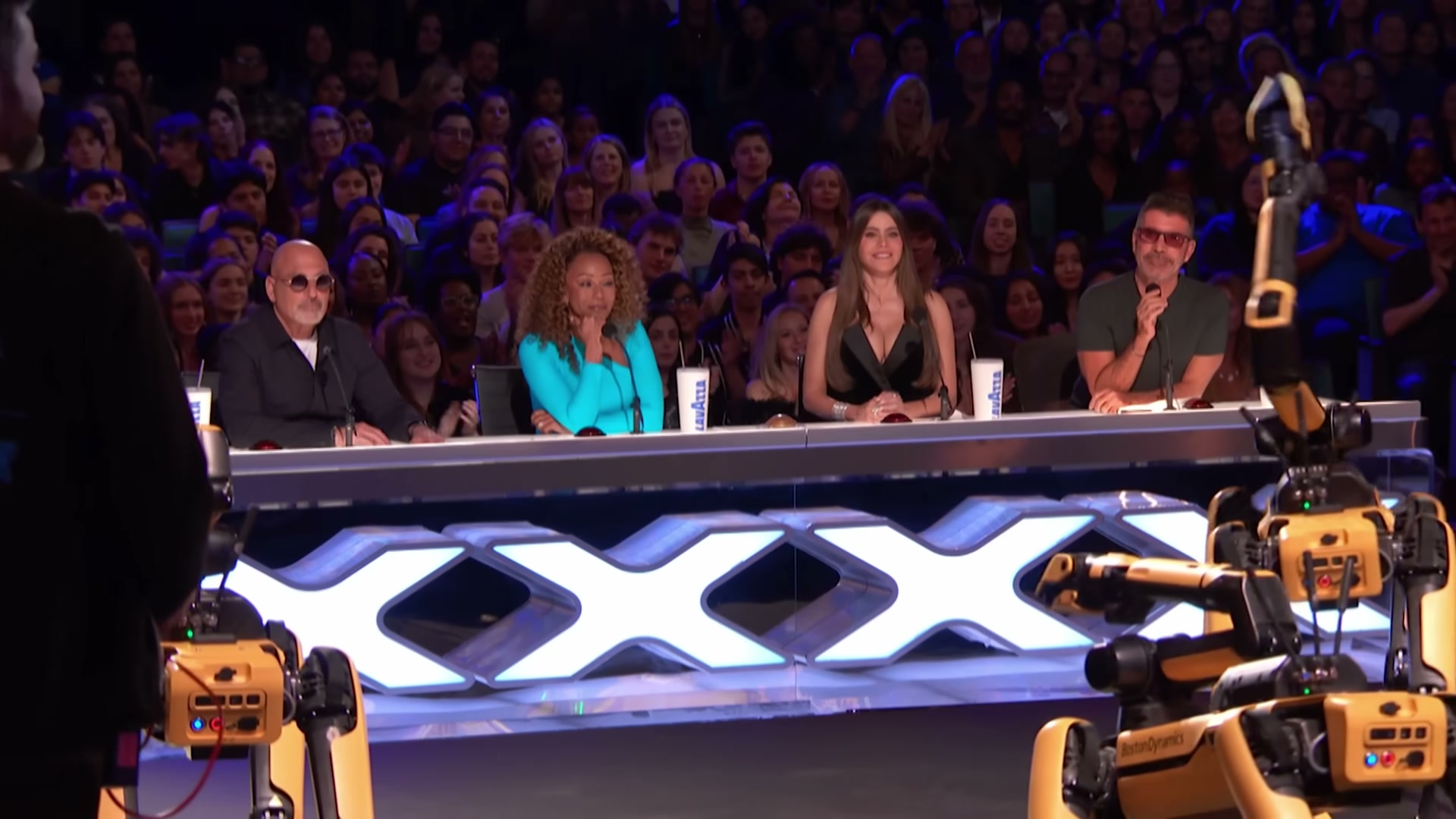
That balance between awe and unease is what made the audition feel culturally current. Robots dancing on a prime-time talent show can inspire excitement about innovation, but also raise questions about how machines will fit into spaces once defined by human performance.
The segment did not need to answer those questions completely. Its job was to entertain, and it did so by making the audience feel the thrill of watching something new happen live, with enough imperfection to keep it from feeling sterile.
The team also hinted at a future in which robots could become part of everyday homes. That claim gave the audition a broader frame, shifting it from a one-night novelty to a public glimpse of technology that may become more familiar over time.
Still, the strongest part of the act was not a prediction about future household machines. It was the immediate theatrical contrast between polished robotics and unpredictable live performance, a combination that made the stage feel both futuristic and classic.
In talent-show terms, the act succeeded because it gave the panel something they had not seen before. After 20 seasons, that is not easy, and the judges made clear that originality mattered as much as technical achievement.
The four yeses confirmed that the audition had done enough to advance. More importantly, they signaled that AGT was willing to treat a robotics demonstration as a legitimate variety act when it delivered surprise, rhythm, and audience reaction.
Boston Dynamics left the stage with a performance that was not perfect, but perfection was never the whole point. The routine became AGT history because it turned a robot failure into part of the entertainment and made a room full of people cheer for machines trying to dance.