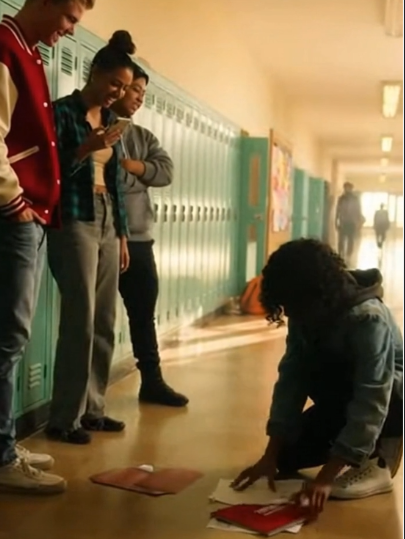
Jason had always been the quiet boy, the one who kept to himself in the corner of the classroom, his gaze often cast downward. His peers knew him as the easy target—the one with the thick glasses, the one who wore too big hand-me-down clothes, the one whose hair was never quite combed right. But it wasn’t just his outward appearance that made him a victim. It was the way he carried himself—meek, shy, always avoiding confrontation. And for years, that made him an easy target for bullies.
Every day, without fail, the taunts and jeers followed him from the moment he stepped onto the school bus to the second he arrived home. The teasing started small at first—mocking comments about his clothes, his handwriting, the way he spoke. But soon it escalated into something more violent. They threw food at him in the cafeteria, tripped him in the hallways, and spread rumors about him that made his name synonymous with weakness.
Jason would come home each day bruised—not just physically, but emotionally. His parents, lost in their own worlds of work and routine, never noticed. They saw the quiet boy at the dinner table, the boy who didn’t speak much, and assumed he was just introverted. They never saw the tears he held back at night, the nights where he lay awake staring at the ceiling, wishing for the world to stop spinning, wishing for his pain to fade.
He tried to be strong. He tried to ignore it, telling himself that if he just endured long enough, it would end. But the bullying didn’t stop. It never did. In fact, it only got worse with time. The constant torment drained him of the energy to speak, to fight back. He became a shadow in his own life, trapped by fear and shame.
But that all changed one fateful afternoon.
Jason was walking home from school, his backpack slung over one shoulder, the weight of the day pressing down on him. He had hoped that today would be different—that maybe today, the bullies would leave him alone. But as he walked past the old brick wall on the corner of the street, he heard their voices behind him.
“Hey, loser!” one of them shouted, followed by the sound of heavy footsteps.
Jason’s heart sank. He knew what was coming. The laughter, the cruel words—it was all too familiar. He could already feel the stares of the other kids around him, their eyes filled with amusement at his misery.
The group of bullies surrounded him, pushing him against the wall, their faces twisted with mockery. One of them, a tall boy named Mark, shoved him roughly. “What’s wrong, freak? Scared of us?”

Jason stumbled, but instead of falling, something inside him shifted. For the first time in years, he felt a surge of anger—a deep, burning frustration that had been building up inside him for as long as he could remember. He had taken their abuse silently for so long, but now, in this moment, it felt like enough.
He straightened his back and glared at Mark and the others. His hands clenched into fists, not in fear, but in defiance. For the first time, he didn’t cower or look away. He looked them all in the eye.
“You think you can break me?” he shouted, his voice rising above the laughter. “You’ve been hurting me for years, but I’m done. I’m not your punching bag anymore!”
The words came out of him like a tidal wave, a release of years of pent-up frustration. His voice was strong, firm, and unwavering. He wasn’t the scared boy they could push around anymore. He was someone different now. The bullies froze, their smirks faltering.
For a few seconds, there was complete silence. Jason’s heart pounded in his chest, and he felt the adrenaline rush through his veins. His hands trembled slightly, but his feet were firmly planted on the ground. He was standing tall, no longer bowed by their cruelty.
Mark, the ringleader, looked at him with a mixture of surprise and confusion. Jason saw the uncertainty in his eyes. The other boys stood behind Mark, suddenly unsure of what to do. It was as though Jason’s words had taken the power away from them, leaving them vulnerable.
The group of bullies, who had once seen Jason as nothing more than an easy target, now seemed unsure. Jason, however, wasn’t waiting for them to recover. He turned and walked away, each step feeling more liberated than the last.
From that day forward, things began to change for Jason. The bullying didn’t stop immediately, but something had shifted inside him. He had found his voice, and that was a victory in itself. He no longer walked the halls with his head down, avoiding the eyes of others. He held his head high, no longer afraid to stand up for himself.
At first, the bullies didn’t know how to react. Some of them still tried to taunt him, but the once-comfortable cruelty had lost its power. Jason’s newfound strength, his confidence, was like a shield they couldn’t break through.
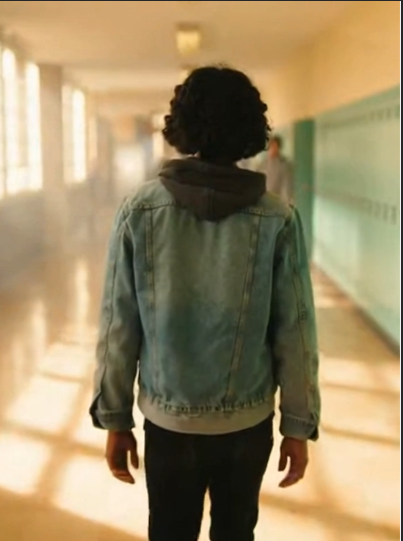
The whispers in the hallway faded, and the jokes became less frequent. Jason wasn’t just enduring anymore—he was living, breathing, and taking control of his own life. He started speaking up in class, participating in discussions, and even making new friends who saw him for who he truly was. His once-silent world began to fill with the voices of people who supported him, who cared about him for who he was.
At home, things also started to change. His parents noticed his newfound confidence. They asked him how his day went, and he no longer kept his struggles hidden. He spoke openly about the bullying, about the pain he had carried with him for so long. His parents, though regretful that they hadn’t seen the signs earlier, were proud of the young man Jason had become.
But the most important change was within Jason himself. He no longer felt small or invisible. He was no longer the boy who was afraid to speak up, the boy who thought his pain was something he had to carry alone. He had found his voice—and that was something no one could take away from him.
One afternoon, weeks after his stand against the bullies, Jason found himself walking down the same street again. He wasn’t afraid anymore. The laughter of the bullies was a distant memory, and he smiled to himself as he passed the old brick wall where everything had changed.
As he walked, a boy from his class, one who had once been a part of the group that tormented him, came up to him. This time, there was no taunting, no mocking. The boy simply smiled and nodded.
“Hey, Jason,” he said. “You alright?”
Jason met his gaze and nodded back. “Yeah,” he said, his voice steady and sure. “I’m alright.”
And for the first time in years, Jason knew that he truly was.
The bullying didn’t stop overnight, but Jason had found something far more important than an end to the torment: he had found his voice. And in that voice was the power to shape his own life, to stand up for himself, and to never let anyone make him feel small again.