Victor Almeida’s shout shattered the calm of the lobby like a gunshot.
“Open this turnstile right now!”
The noise in the building—chatter, phones ringing, the hum of air conditioning—fell dead silent. The only sound was the cruel “beep, beep” of his blocked badge.
Victor Almeida, heir to the textile empire bearing his name in gold, slammed his fist against the thick glass door of the turnstile. Sweat dripped down his forehead, his face flushed with rage. Sitting in his wheelchair, he pushed the wheels violently, the metal crashing against the steel barrier, as if anger alone could break it.
“Are you deaf, Harris?” he shouted hoarsely, his voice grating, like someone who hadn’t shouted in far too long. “I own this company! Open it!”
Across the turnstile, Harris, the head of security, stood, arms crossed. His gaze darted around the room like he was searching for an escape route that didn’t exist.
“I can’t, sir…” Harris murmured, unable to meet Victor’s eyes. “Your badge… it’s blocked in the system.”
“Blocked? Me?” Victor laughed in disbelief, but it was a hollow laugh. His frustration boiled over, and he tried to force his way through, pulling his chair forward and slamming the footrests into Harris’ leg.
Harris stepped back, but before the door could open, two younger guards closed in like a wall.
“It’s a higher order, sir…” Harris’ voice had hardened, trying to conceal his shame. “An order from Mr. Lucas. He said you’ve been removed… that you’re unstable.”
“Unstable.” The word hit like a slap. It echoed across the room, leaving a bitter silence. Victor’s anger flared as his blood boiled, and the employees froze. Some discreetly raised their phones, recording.
“Is that what they think?” Victor trembled, gripping his chair. “That I’m insane?”
A voice floated down from the mezzanine above.
“What a pathetic scene, don’t you think, cousin?” Lucas Almeida’s voice was smooth, venomous, as he stood above them in a sharp navy suit and gold watch, a half-smile playing on his lips.
Victor’s anger surged.
“Come down and say it to my face!” he shouted. “Today we vote on the sale!”
Lucas adjusted his watch with casual indifference.
“The vote is for the executive board, Victor,” Lucas said, his words laced with mockery. “Not for disabled former employees.”
The word “disabled” was spat with sadistic pleasure. Victor felt his blood boil.
“I will vote. The company is mine,” Victor snarled.
“Oh really?” Lucas raised an eyebrow, amused. “Then come up. Third floor. But what a shame… we had a ‘power surge.’ The elevators burned out.”
Victor’s eyes shot to the elevator panel—dark. A lie. Everyone knew it, but no one spoke.
“Take the stairs,” Lucas spread his arms theatrically. “It’s only three floors. Show everyone you’re capable, or stay there crying.”
Lucas walked away, his laughter soft and cold.
Victor didn’t think. He acted.
He locked the wheels of his chair and threw himself forward. His body slammed onto the floor with a thud. The impact knocked the air from his lungs, but the humiliation cut deeper than the pain.
The crowd watched in stunned silence. Not one person moved to help. Only phones, recording the scene.
He dragged himself forward, his useless legs dragging like dead weight, until he reached the staircase. It loomed before him, an insurmountable mountain.
Victor tried the first step. He failed. His forehead hit the cold marble. There, on his knees, he broke—not from pain, but from humiliation.
Then, out of nowhere, a bucket of water splashed across the floor, hitting expensive shoes.
“Watch it!”
But Maya didn’t care.
She was twenty-five, wearing an oversized cleaning uniform and yellow gloves, her curly hair tied back. She had seen it all—the cruelty, the silence, the cowardice. Something inside her burned with defiance.
“Cowards…” she muttered as she pushed through the crowd.
She knelt beside Victor.
“Sir,” she said urgently.
“Go away…” he whispered, his voice breaking. “Don’t look at me.”
But Maya didn’t offer pity. She offered action.
“You’re not staying here for him to laugh at you,” she said firmly. “Get on my back.”
Victor blinked. “That’s impossible…”
“What’s impossible is staying here,” she cut him off. “Hold on.”
Harris tried to intervene. “Maya! Stop! You’ll get fired!”
She turned, her eyes blazing.
“What’s dirty is your conscience.”
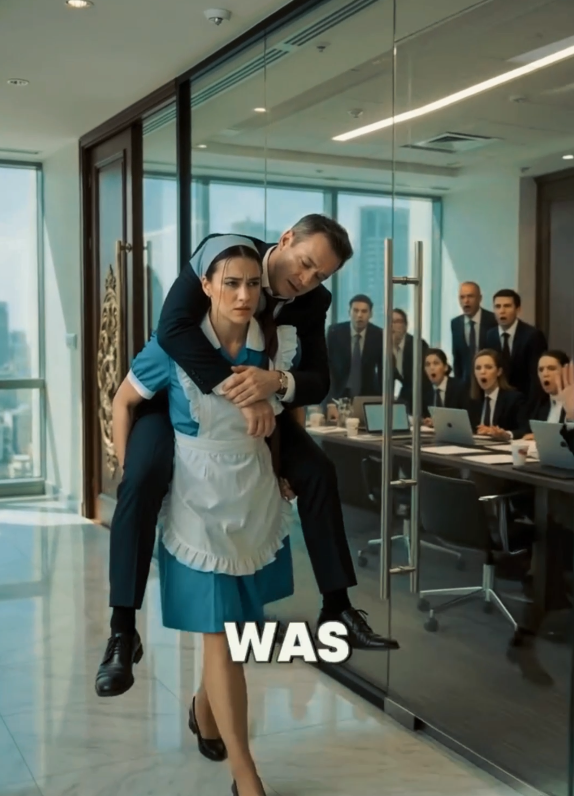
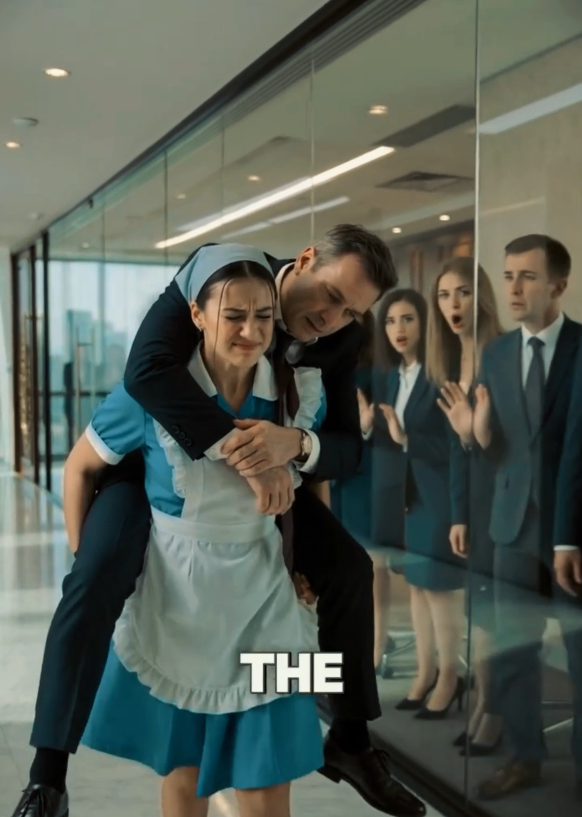
And with that, Maya helped Victor onto her back. It wasn’t easy. Her muscles shook with effort, but she stood.
The first step echoed through the lobby like a vow.
On the second floor, her body began to falter. Breathing ragged, her knees trembling.
“You won’t make it,” Victor whispered.
“Be quiet,” she gritted out through clenched teeth.
Then, she slipped.
Her knee slammed into the marble with a sickening crack. Blood seeped out.
“Put me down!” Victor cried out.
“I’m… not… quitting,” Maya whispered, her body shaking.
With every step, her body screamed in pain, but she carried him.
They reached the third floor.
“Stop! You can’t enter like this!” Clara shouted.
Victor remained calm. “Open,” he said.
Clara hesitated, but the door opened.
Inside, twelve executives sat, stunned. Lucas froze, his pen hovering mid-air.
Maya placed Victor in the chair with determination.
“We’re a bit late,” Victor said coldly. “The elevator ‘burned,’ remember?”
Lucas tried to smile. But it faltered.
Victor slammed his fist on the table. “I have 51%. My vote is no.”
Power shifted in an instant.
Lucas was dragged out.
Victor collapsed into the chair, but Maya caught him, holding him up.
And the war began.
Weeks later, betrayal unfolded. Evidence was planted. Victor was drugged. Maya was arrested.
But one detail survived.
A hidden camera.
The truth.
In court, everything exploded—the video, the lies, the setup.
Lucas screamed in denial, but it was too late.
Victor stood tall.
“I’m not insane,” he said, his voice strong. “I just woke up.”
Arrests followed.
Maya was freed.
She ran to him, and he held her like everything depended on it.
“You’re my hero,” he whispered.
A year later, the mansion came back to life.
Victor walked—with effort, but he walked.
Maya held their child.
And for the first time, everything felt right.
Because sometimes, it only takes one person.