Victor Borge built a legendary career on a deceptively simple premise: take classical music seriously enough to play it beautifully, then immediately expose its conventions as ridiculous. His live performances became a masterclass in the art of making virtuoso skill look effortless and formal traditions look absurd, all without alienating the audience or diminishing the art form he was gently mocking.
Across decades of sold-out shows, television appearances, and recordings, Borge proved that reverence and ribaldry are not opposites but natural partners. He was, in his own words, a comedian who happened to play piano, though his fans would argue the two gifts were impossible to separate.
Born in 1909 in Copenhagen, Borge showed prodigious musical talent from childhood, studying with some of Europe’s most demanding teachers and eventually building a conventional concert career. He made his debut as a pianist at age twenty-two, but the turning point came when he discovered that audiences laughed more readily at a pianist who stumbled than at one who succeeded flawlessly.
This revelation did not diminish his technique; it weaponized it. By the mid-1930s, Borge had fully committed to a stage act that fused Chopin with comedy,Mozart with mockery, and Liszt with slapstick, creating a hybrid no one had quite attempted at such a high level before.
He brought the same rigor to his jokes that he brought to his scales, and audiences sensed the deliberate craftsmanship behind every seemingly spontaneous gag.
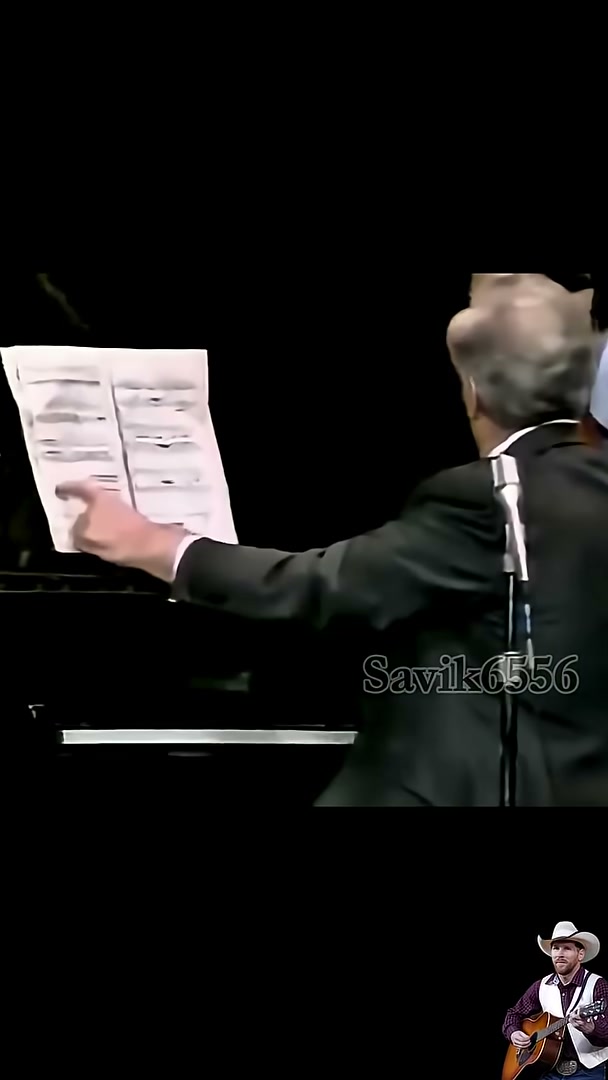
The clip in circulation captures Borge mid-performance, sheet music resting on the piano stand as though a conventional recital is about to unfold. Within seconds, the illusion shatters.
He lifts the sheets, examines them with exaggerated scrutiny, holds them up for the audience to see, and ultimately dismisses them entirely with a theatrical gesture of mock accusation. The moment is beautifully orchestrated: Borge never stops playing, never fumbles, never breaks the flow of the music.
The piano continues singing while the written score dangles in his hand, and that contrast is the entire joke. A genuinely skilled performer is openly admitting he does not need what the tradition says he must have, and the audience roars with delight at the audacity of it.
It is a small revolution played out on a piano bench.
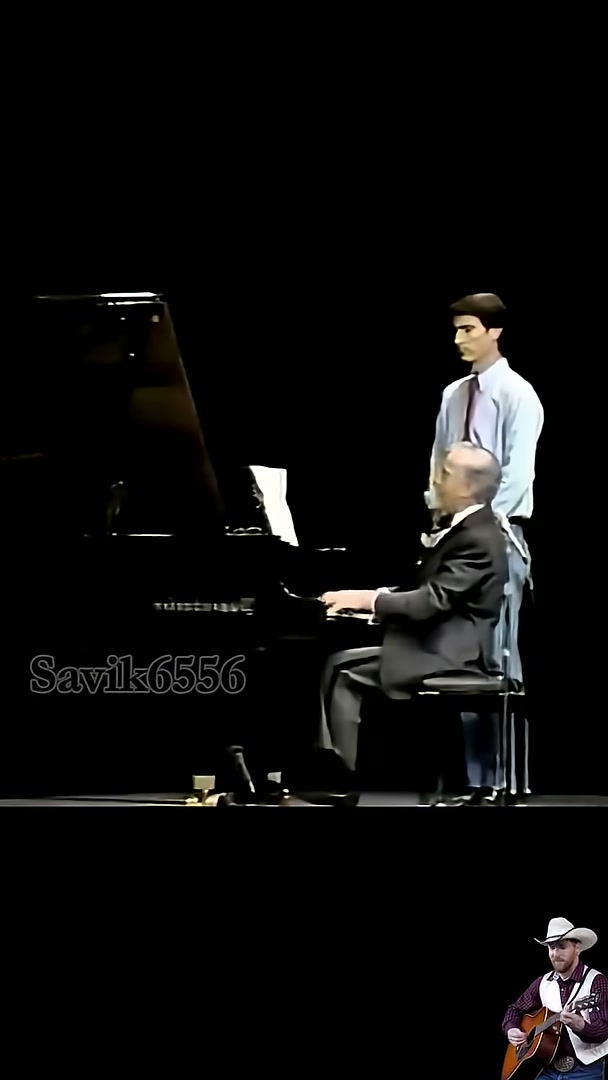
What makes the bit land so effectively is Borge’s deadpan delivery. His face betrays nothing while he commits an act of musical insurrection; his expressions cycle through mock betrayal, mock outrage, and mock resignation in perfect time with the music still pouring from his fingers.
He points at the empty music stand as if laying formal blame on an inanimate object, and the gesture is so precisely timed that it feels less like improvisation and more like choreography. Every raised eyebrow, every theatrical sigh, every pointed finger is calculated to land at the precise musical phrase that makes the incongruity funniest.
Borge understood rhythm in the broadest sense: the rhythm of a joke, the rhythm of a melody, and the rhythm of an audience’s laughter are not separate skills but expressions of the same instinct. He spent decades refining that instinct until the timing became indistinguishable from magic.
The broader significance of this routine extends well beyond one pianist’s personal joke. Classical music in the early and mid-twentieth century carried an enormous burden of formality.
Concert halls demanded silence, dress codes, and a near-religious reverence for composers and performers alike. Borge walked into that world with a bow tie and a grin and proceeded to poke gentle holes in every pretension.
He never mocked the music itself; he mocked the rituals surrounding it. By discarding the sheet music, he was not dismissing the value of written composition but rather suggesting that genuine musical connection transcends paper.
The joke works only if the audience believes in the music’s seriousness, and that belief is exactly what Borge reinforced through his continued flawless playing. He used the formal shell of classical performance to create comedic space, then filled that space with genuine artistry.
Audience reaction in the clip is immediate and sustained, rising in waves that Borge visibly feeds off as he performs. He was a consummate crowd reader, adjusting his timing and energy based on the room’s temperature in real time.
That adaptability was not a backup plan; it was the core of his act. Unlike comedians who rely on scripted material, Borge built his routines around a pianist’s improvisational mindset, treating each performance as a live collaboration between himself and the people in the room.
The laughter was not a decoration bolted onto a piano recital; it was an integral instrument in the performance, and Borge played it as deftly as he played any Chopin étude. The warmth in the applause at the end of the routine signals something deeper than mere appreciation for a clever gag.
It registers as genuine affection for a performer who made people feel that classical music belonged to them, that it was not a distant monument but a living, breathing thing that could be laughed at and loved at the same time.

Borge’s influence on the intersection of comedy and music is difficult to overstate, even if it rarely receives the scholarly attention it deserves. He predated the modern era of crossover entertainers by decades, functioning as a direct ancestor to performers who today blend genres without apology.
He demonstrated that virtuosity does not require solemnity and that humor does not require the sacrifice of skill. Subsequent generations of musical comedians, from Weird Al Yankovic to today’s piano YouTubers who inject commentary into classical performances, operate within a tradition Borge helped establish.
The fact that this particular clip continues to circulate and generate new audiences speaks to the timelessness of the basic impulse: watching someone who is brilliant at something refuse to take it seriously, while remaining brilliant, is perpetually funny. It reassures viewers that mastery and humility can coexist, that the best artists are often the ones most willing to laugh at themselves.
Beyond influence, Borge’s work serves a genuine cultural function that deserves recognition on its own terms. Classical music, for all its richness, has historically struggled with accessibility, presenting barriers of language, education, and social convention that can alienate casual listeners.
Borge demolished those barriers without dumbing anything down. He never played badly to make a point; he played exceptionally well and invited the audience to share in the joke.
The result was that countless people who would never have attended a standard recital found themselves laughing along to a Chopin piece and, in the process, actually listening to Chopin. He was, perhaps unintentionally, one of the most effective classical music ambassadors of the twentieth century, not because he simplified the repertoire but because he humanized the context around it.
Audiences left his shows loving the music more, not less, precisely because he had shown them it was safe to smile.
The specific power of the sheet-music gag lies in its elegant simplicity. There are no elaborate props, no costume changes, no extended narrative setup.
The comedy emerges entirely from the juxtaposition of continuing to play beautifully while rejecting the very tool the tradition demands. It is a statement about the relationship between knowledge and instinct, between written instruction and lived performance, between what is prescribed and what is actually felt.
Borge understood that