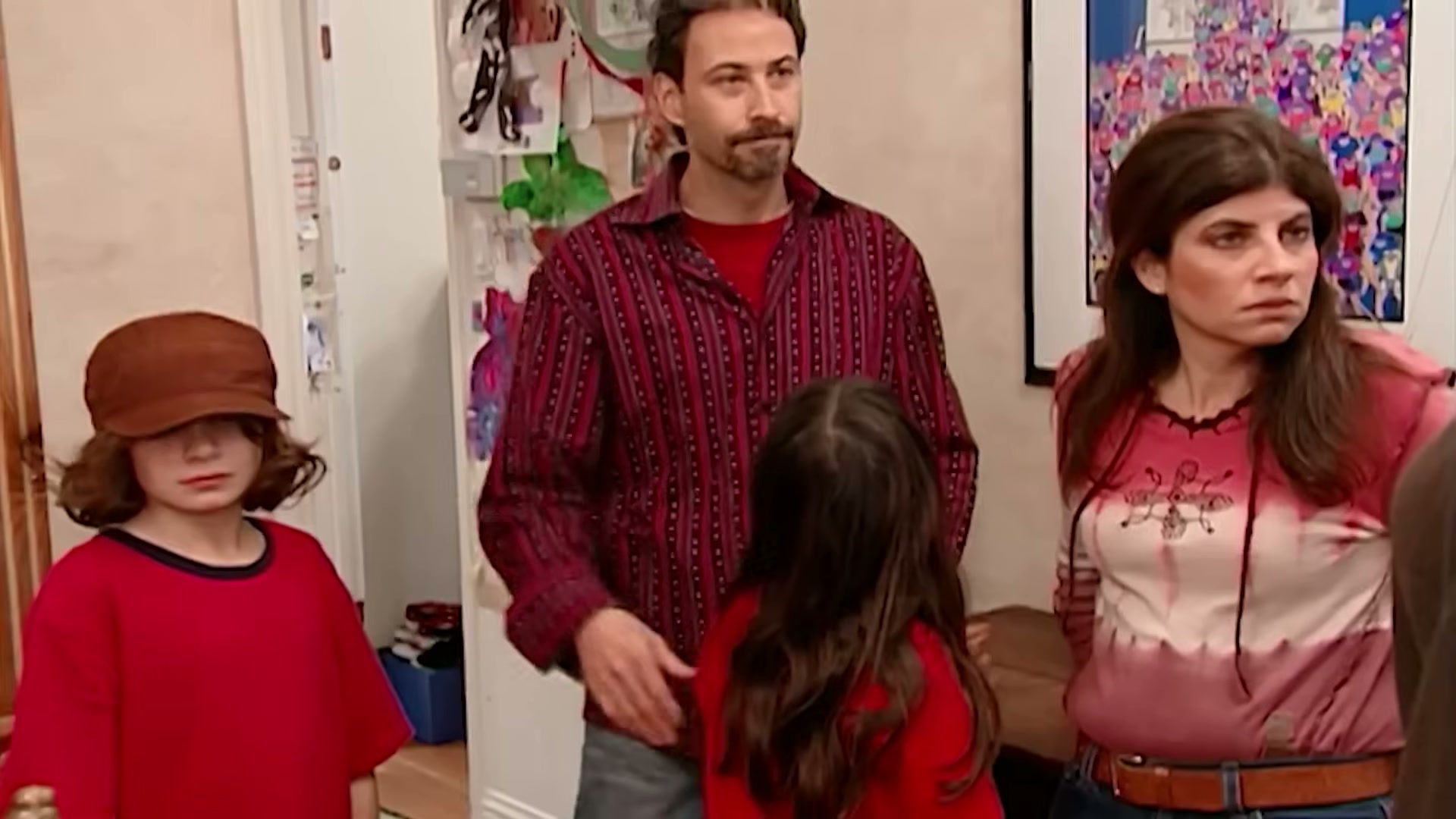
The compilation presents family conflict at its loudest and most emotionally charged, but its real focus is not spectacle alone. Beneath the shouting, resistance, and dramatic standoffs is a study of how inconsistent discipline can turn ordinary moments into full household crises.
Supernanny has always built its format around intervention, observation, and practical correction, and this collection leans heavily into the most intense examples. It shows children testing limits with remarkable persistence while exhausted parents struggle to respond without becoming angry, reactive, or overwhelmed.
One early sequence centers on a mother trying to manage several children at once during a moment that should have remained minor. Instead, a disagreement over food quickly becomes a flashpoint for teasing, disobedience, competing demands, and rising frustration.
The scene is compelling because the original issue is almost trivial, yet the family system around it is fragile. A child wants something, another child provokes the situation, instructions are ignored, and the parent’s authority begins to collapse under the pressure of multiple simultaneous battles.
As the mother attempts to enforce consequences, the children continue to resist and distract one another. What should be a simple correction becomes a chain reaction, with each new protest making it harder for the parent to remain calm and consistent.
Jo Frost’s role in this situation is not to simply label the children as badly behaved. Her analysis points instead to patterns in the household, especially the way adult uncertainty gives children room to challenge boundaries again and again.
The most revealing moment comes when the mother threatens to involve the father, who is away at work. On the surface, the call appears to be a last resort, but Jo identifies it as a major problem because it suggests the mother’s own authority is not enough.
That observation reframes the entire conflict in a sharper way. If children believe one parent can only enforce rules by invoking another, they learn to delay, negotiate, and escalate until the stronger consequence appears.
This does not mean the mother is uncaring or unwilling to parent effectively. The footage shows a parent under stress, trying to hold the line while feeling outnumbered, embarrassed, and emotionally drained.
The difficulty is that stress changes the tone of discipline. Once frustration takes over, instructions become louder, consequences become less predictable, and children often respond by pushing even harder.
Jo’s coaching emphasizes that discipline must be calmer than the behavior it is trying to correct. The parent cannot win a contest of volume or emotion, because the goal is not to overpower the child but to teach that rules remain steady regardless of the child’s reaction.

The compilation also includes a dinner-table confrontation with a young child who refuses to cooperate and repeatedly tries to draw his parents into an argument. His behavior is provocative, but the key lesson is how easily adults can become trapped by answering every remark.
In that scene, the child uses defiance, interruptions, and hurtful language to keep control of the emotional temperature. Each response from the parents risks rewarding the behavior with attention, even when the attention is negative.
Jo’s advice is clear: stop engaging with the performance and focus only on the consequence. When a child is placed in time-out or another corrective space, the adults must avoid debates, lectures, and emotional exchanges that turn discipline into a negotiation.
This is one of the central ideas running through the compilation. Many of the most dramatic moments happen not because a child breaks a rule once, but because the follow-through becomes inconsistent after the rule is broken.
A parent may give an instruction, then repeat it, then warn, then explain, then argue, and finally react in anger. By that point, the child has learned that the first instruction is not the real boundary and that persistence may eventually change the outcome.
The program’s method tries to reverse that pattern through repetition and restraint. A calm instruction is given, a consequence follows, and the adult refuses to be pulled into the emotional storm surrounding it.
That may look simple from the outside, but the footage shows how hard it is in practice. Parents are not dealing with theoretical behavior; they are dealing with real noise, embarrassment, fatigue, sibling dynamics, and the fear that they are losing control.
The most balanced reading of these scenes recognizes both sides of the struggle. The children’s behavior is disruptive and unacceptable, but the parents’ reactions are also shaped by stress and by discipline habits that have developed over time.
The compilation’s strongest moments come when Jo separates blame from responsibility. She does not excuse the behavior, but she also makes it clear that children often repeat strategies that have worked for them before.
If shouting delays bedtime, if insults trigger a long argument, or if refusal brings another parent into the conflict, those behaviors gain power. The child may not understand the larger pattern, but the household still trains the behavior through repeated outcomes.
This is why Jo keeps returning to consistency as the foundation of change. Consistency does not mean harshness; it means the child can predict that the same rule will be enforced in the same calm way every time.

The emotional tone of the compilation is deliberately intense, and viewers are positioned to feel shock as the confrontations unfold. Yet the most useful parts are not the loudest moments, but the quieter shifts when parents begin to act together and stop reacting impulsively.
When adults present a united front, the child has fewer openings to divide, delay, or bargain. Even more importantly, the child begins to experience discipline as structure rather than personal conflict.
The dinner-table segment demonstrates this shift with particular clarity. Once the parents stop feeding the provocation, the child’s attempts to escalate begin to lose their effectiveness.
That does not produce instant peace, and the compilation avoids pretending that change is effortless. The child still resists, tests, and tries familiar tactics, but the adults are coached to stay with the process instead of abandoning it when it becomes uncomfortable.
The earlier household sequence follows a similar emotional arc. The mother’s panic and frustration are understandable, but Jo’s intervention shows that authority must be practiced directly rather than borrowed from an absent parent.
This point is especially important because it affects family roles beyond a single argument. If one parent becomes the everyday enforcer only in name while another parent becomes the ultimate threat, the household hierarchy becomes unstable.
Children need to know that each caregiver can set limits and carry them through. They also need to see that adults support one another without using one another as weapons in the moment.
The compilation is dramatic television, so it naturally highlights the most explosive scenes. Still, its underlying message is practical and widely recognizable: small conflicts grow large when boundaries are unclear and emotions become the main language of discipline.
Its best insight is that calm authority is not passive. It requires preparation, confidence, repetition, and the willingness to tolerate a child’s displeasure without surrendering the rule.
By the end, the emotional payoff comes less from perfect behavior than from a visible change in adult response. The parents begin to understand that control is not achieved through louder threats, but through steady follow-through and shared expectations.
That makes the compilation more than a collection of shocking family moments. It becomes a reminder that the path out of chaos often begins when parents stop reacting to every provocation and start leading with consistency, composure, and unity.