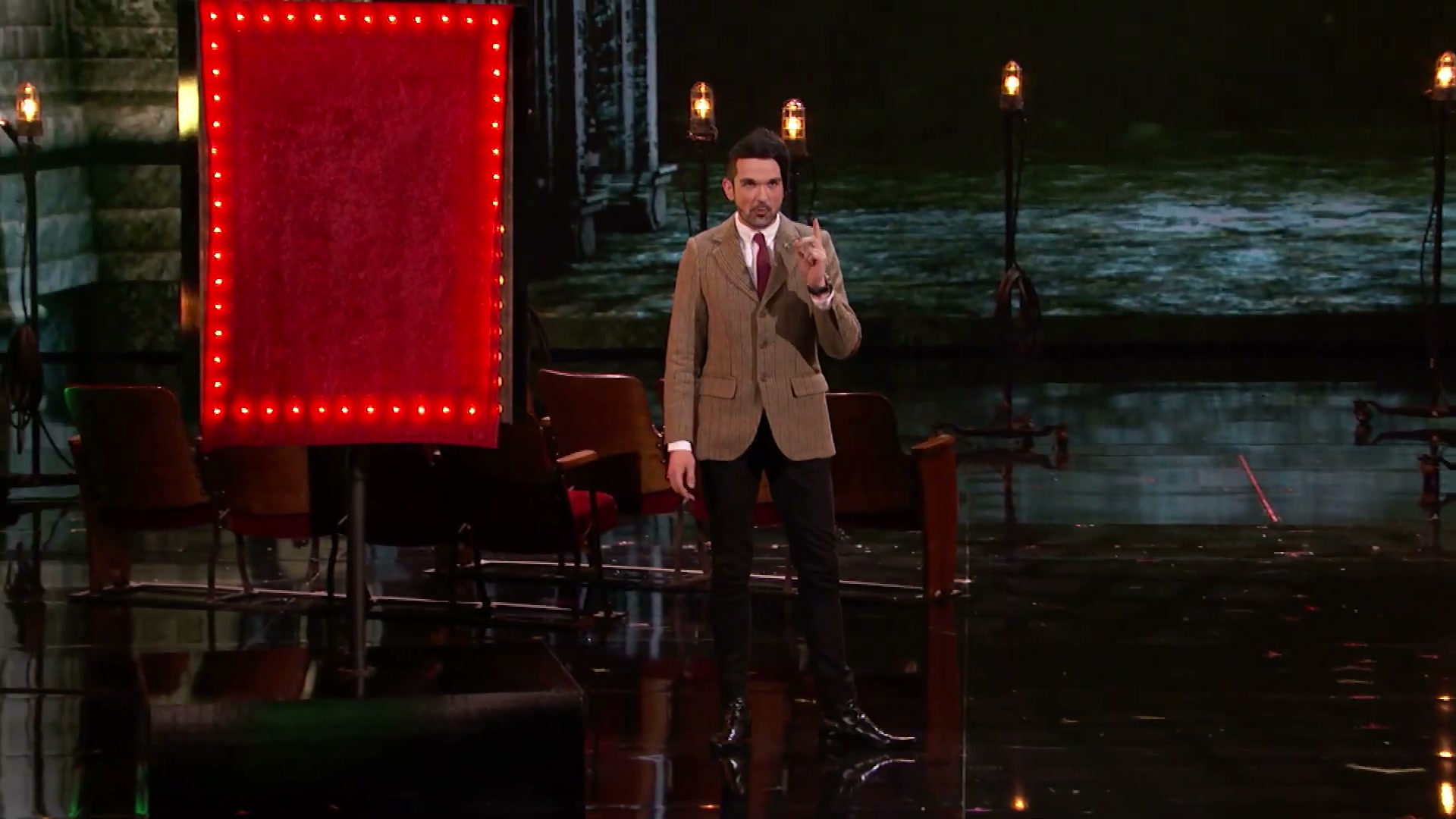
The semifinal stage of America’s Got Talent is designed for performers who can turn a familiar skill into something larger, riskier, and more theatrical. In this performance, a mentalist built his act around social media participation, asking the audience to believe that thousands of viewer tweets could be narrowed to one impossible prediction.
He began by keeping the mood light, using self-deprecating humor to ease the room into an act that would soon depend on tension and trust. That opening mattered because mentalism often lives or dies on rapport, and the audience needed to feel both entertained and invited before the mechanics of the routine became more complex.
The performer also reminded viewers of earlier feats, including demonstrations that appeared to reveal private thoughts and personal information from the judges. By referencing those moments, he gave the semifinal routine a sense of continuity, suggesting that this was not a standalone trick but an escalation of a persona already established on the show.
The central premise was built around a challenge issued weeks before the performance, when viewers were asked to tweet a random celebrity, city, and object. Those responses became the raw material for the routine, with thousands of printed tweets distributed throughout the theater to create the impression of a massive, unpredictable field of possibilities.
That social media angle gave the act a timely feel, turning passive viewers into apparent participants in the outcome. Instead of asking a single audience member to think of a word or select a card, the performance drew from a national pool of responses, which made the eventual prediction feel broader and more consequential.
To underline the difficulty, the performer stressed the mathematical odds against correctly predicting the final combination. He cited a figure of more than one in 43 quadrillion possible outcomes, a number so large that it functioned less as a statistic than as a dramatic device, signaling that success would seem nearly impossible.
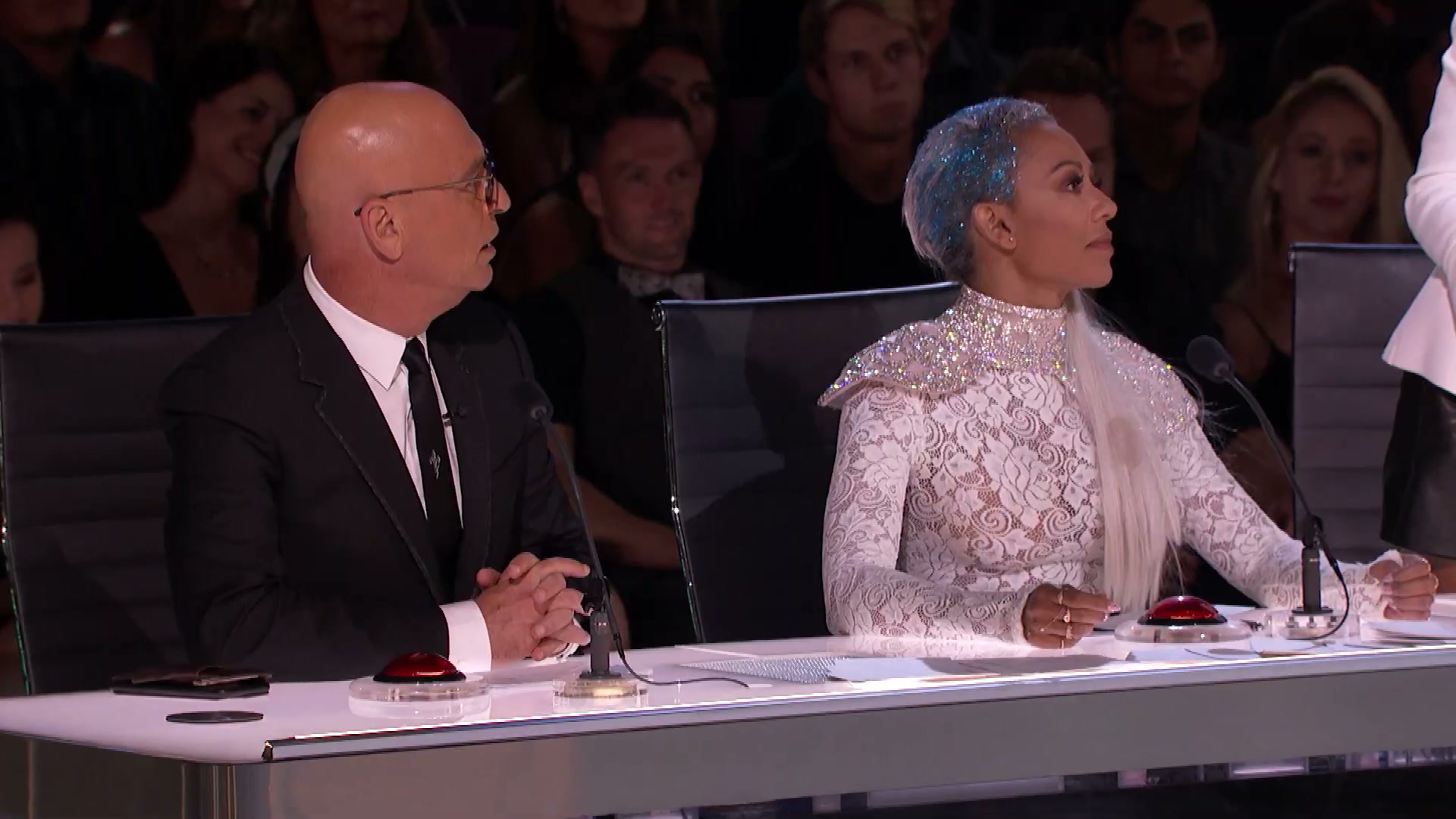
The staging then shifted control away from the performer and toward the judges, which was essential to the credibility of the routine. Howie Mandel and Simon Cowell were sent into the crowd to gather tweets, making the selection process visible and giving the audience a chance to watch the pieces move through multiple hands.
Mel B’s role added another layer of apparent randomness, as she inspected and scattered the collected papers before the final choice was made. This sequence slowed the pace in a useful way, allowing the suspense to rise while reinforcing the idea that the performer was not simply guiding one person toward a predetermined answer.
The final selection was made by Heidi Klum, whose chosen tweet contained the combination “Ellen, Rome, cheese.” On its own, the phrase was quirky and almost absurd, but that oddness served the act well because it felt unlikely, specific, and difficult to force naturally in conversation.
The audience reaction throughout the process reflected a mix of curiosity, amusement, and anticipation. Each time the judges handled the tweets or the odds were emphasized, the theater seemed to lean further into the premise, waiting to see whether the final reveal could justify the elaborate setup.
As a semifinal act, the routine had clear strengths, especially in how it used scale and participation to make a mentalism effect feel suitable for a large television stage. Rather than relying only on close-up mystery, it transformed viewer interaction, judge involvement, and statistical improbability into the building blocks of a prime-time spectacle.
There were also inherent challenges in presenting a routine like this, because the more complicated the selection process becomes, the more carefully the performer must maintain clarity. The act depended on viewers understanding that the tweets were real submissions, that the judges had meaningful control, and that the chosen words were not easily anticipated.
The phrase “Ellen, Rome, cheese” became the dramatic hinge of the performance because it turned a chaotic mass of responses into a single, memorable target. The humor of the combination helped prevent the routine from feeling overly solemn, while its specificity gave the prediction element the weight it needed.
What made the presentation engaging was not just the promise of a reveal, but the way the act kept changing focus. It moved from comedy to biography, from online participation to live theater, and from mathematical scale to a simple slip of paper held by a judge.
That structure gave the routine a strong sense of momentum, even before the final payoff. Each stage answered a potential doubt by adding another witness, another shuffle, or another public decision, which helped the performance feel transparent within the conventions of a televised magic act.
The judges’ involvement was particularly important because their reactions often guide the home audience’s emotional response. By placing them in the center of the selection process, the act encouraged viewers to see the outcome through their surprise, scrutiny, and visible engagement.
The use of Twitter also reflected how talent competitions were adapting to a more interactive entertainment culture. A performance no longer had to remain confined to the stage; it could begin weeks earlier online, collect public input, and return that participation to the theater as part of the drama.
In that sense, the act was as much about presentation as prediction. The performer understood that a semifinal audience expects ambition, so he expanded a mentalism premise until it involved thousands of submissions, multiple judges, and a final result that sounded too strange to be convenient.
The performance succeeded in creating a high-stakes atmosphere from ordinary words submitted by viewers. Whether approached as mind reading, theatrical illusion, or carefully engineered showmanship, it delivered the kind of suspense that fits the pressure of a live competition semifinal.
By the time the chosen combination was revealed, the room had been primed to treat three random words as the center of a major event. That transformation was the act’s real achievement, turning tweets, paper slips, and judge participation into a polished demonstration of timing, confidence, and audience control.