The latest family check-in on Supernanny focuses on a household still learning how to move from chaos to consistency. After several days away, Jo Frost returns to see whether the parents have been able to maintain structure without her standing beside them.
The family’s challenge is significant, with two sets of twins creating constant noise, competition, and testing of boundaries. The segment frames the visit not as a dramatic confrontation, but as a practical review of what is working, what is slipping, and where the adults still need to grow.
Jo arrives with a mixture of hope and concern, explaining that she is eager to see whether the guidance has taken root. Her return carries a clear question for the parents: can they apply the tools when the pressure rises and the children push back?
The review begins with video footage, allowing everyone to observe the family’s behavior from a more objective distance. This is one of Jo’s most useful methods, because it removes excuses and lets the parents see the difference between intention and impact.
One of the early clips shows a child giving an apology that sounds more angry than sincere. Jo immediately identifies the moment as a missed opportunity, explaining that an apology should come after a child has calmed down enough to understand what happened.
Her point is not that a child must perform remorse perfectly, but that parents should not accept words that are clearly being used to end a consequence without real reflection. In this case, she says the better response would have been to send the child away to settle, then bring him back to try again properly.
That advice highlights a key theme of the episode: discipline is not simply about stopping behavior in the moment. It is also about teaching children how to regulate emotion, repair harm, and understand that consequences are connected to choices.
The parents are also shown taking a healthier step by removing soda from the home. Jo praises the decision, recognizing that reducing sugar can support better routines, calmer energy, and improved family habits.
However, she also reminds them that a household rule is stronger when children understand the reason behind it. Rather than simply taking something away, the parents are encouraged to explain that the change is about health, balance, and making better choices as a family.
This small detail matters because the show is not presenting discipline as control for its own sake. Jo consistently pushes the adults to combine authority with communication, so the children are not merely obeying rules but slowly learning the values behind them.
The strongest progress appears in footage of the father handling a difficult playtime moment. He uses a slower voice, calmer delivery, and clearer instructions, which immediately makes him appear more confident and in control.
Jo responds positively to this improvement, praising the way he avoids shouting and instead projects authority through tone and timing. She notices that he gives the children choices, making the boundaries clear while still allowing them some agency.

This is a major shift because many overwhelmed parents confuse volume with strength. The footage shows the opposite: the more measured the adult becomes, the more powerful the instruction can feel.
By slowing down, he gives the children less emotional chaos to react against. His steadier voice signals that he expects cooperation, and that expectation itself becomes part of the discipline.
Jo’s approval is important because it validates that the family is not failing across the board. There are real signs of progress, and the father’s improved approach shows that the methods can work when applied with consistency.
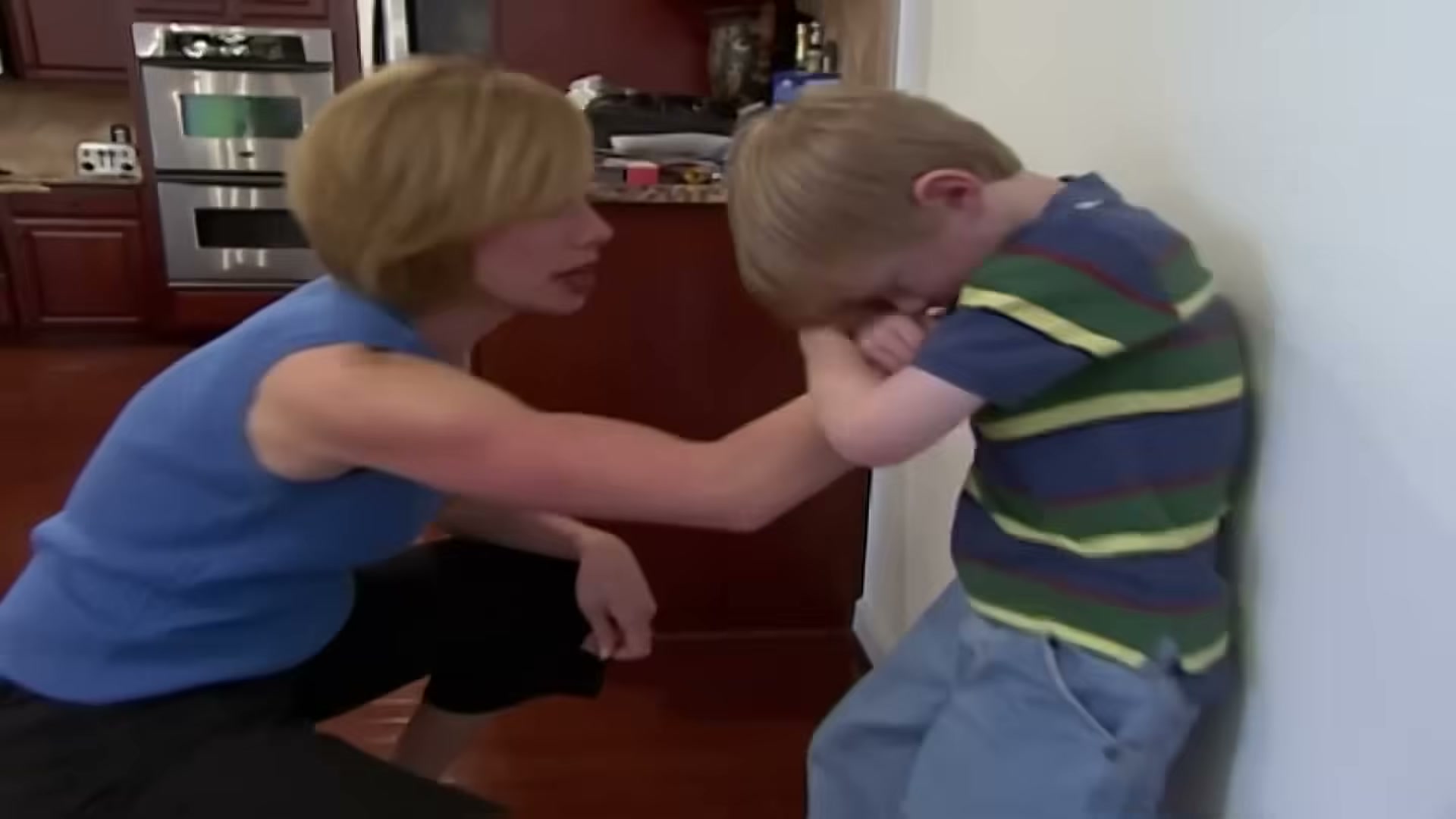
The segment then turns to the mother, and the tone becomes more challenging. Her footage shows her trying to direct the children, but the room remains loud, scattered, and difficult to manage.
She calls out names and gives instructions, yet the children continue yelling, throwing things, and ignoring her. The problem is not that she lacks concern or effort, but that her delivery does not yet command attention.
Jo is direct about what she sees, telling her that voice, posture, and confidence must improve. The critique is firm, but it is not cruel; it is rooted in the belief that the mother can become stronger if she understands what her children are responding to.
Repeatedly calling children’s names without follow-through can train them to tune the adult out. Jo wants the mother to recognize that every ignored instruction weakens authority unless it is paired with clear action and consistent consequences.
The emotional difficulty for the mother is clear, because she is trying to manage a demanding household while feeling judged by the results. Yet Jo’s feedback suggests that assertiveness is not about becoming harsh or unkind, but about becoming believable.
Children in high-energy homes often look for the adult who seems most certain. If a parent appears unsure, hesitant, or physically overwhelmed, children may keep pushing because the boundary does not feel solid.
That is why Jo focuses not only on words, but on body language. Standing with purpose, lowering the voice, making eye contact, and moving closer can all communicate authority before a parent even finishes a sentence.
The contrast between the parents becomes the episode’s central teaching tool. One parent is beginning to slow down and lead with calm control, while the other is still trying to regain order through repetition and urgency.
This contrast is not presented as a competition between them. Instead, it shows how a family system changes unevenly, with one adult sometimes adopting new strategies faster than the other.
Jo’s role is to keep both parents accountable without ignoring the progress already made. She praises the father where praise is due, but she also keeps attention on the mother’s need to develop the same level of presence.
The segment is effective because it avoids pretending that a few days of coaching can transform everything. Real change in parenting often looks uneven, uncomfortable, and full of small corrections.
The children’s behavior remains difficult, but the adults are beginning to see the patterns more clearly. That clarity is the first step toward changing the atmosphere of the home.
A major lesson from the episode is that discipline has to be consistent across moments, not just attempted during crises. If a child gives a false apology, ignores an instruction, or escalates during play, the adult response must be calm, predictable, and connected to the behavior.
Another lesson is that healthier choices, like removing sugary drinks, should be integrated into a broader family message. Rules become more meaningful when parents explain them with confidence rather than presenting them as sudden punishments.
The mother’s struggle is the most emotionally resonant part of the segment because many viewers can recognize the exhaustion behind her voice. She wants to be heard, but wanting control and projecting control are not the same thing.
Jo’s guidance suggests that she must stop chasing compliance and start creating it through structure. That means fewer repeated warnings, clearer commands, and faster follow-through when children ignore expectations.
The father’s success offers a practical model for that change. His calmer pace shows that authority can feel grounded rather than aggressive, and that children often respond better when an adult lowers the emotional temperature.
Still, the segment does not imply that one parent can carry the household alone. For lasting change, both adults need to use the same expectations, the same consequences, and the same confidence.
The review ends with a sense of cautious progress rather than complete resolution. The family has made meaningful changes, but the hardest work now falls on sustaining them when Jo is no longer in the room.
What makes the episode compelling is its balance of encouragement and pressure. Jo celebrates improvement, but she refuses to let good intentions stand in for effective parenting.
The mother is left with a clear challenge: she must learn to occupy her authority fully. Not louder, not angrier, and not more frantic, but steadier, firmer, and more certain.
In a busy home with several young children, that shift can make the difference between constant reaction and real leadership. The segment ultimately argues that children need love, but they also need adults who can set limits and mean them.
Supernanny’s review of this family shows that progress is rarely a straight line. The parents have begun changing the household culture, but the next step is making calm authority a daily habit rather than a coached performance.