
The lyric video built around “Forever Young” works because it understands that nostalgia is rarely simple happiness. It uses a familiar 1980s synth pop anthem to reopen questions about youth, time, memory, and the quiet fear that life moves faster than people expect.
Rather than telling a conventional story, the video lets the song’s words become the narrative. Its focus on lyrics invites viewers to hear the track not only as a radio classic, but as a meditation on what it means to want a moment, a feeling, or a version of oneself to last.
The opening images in the transcript create a world of contrasts, with people compared to water, heat, melody, and beat. Those comparisons suggest that human lives can be fluid, intense, harmonious, or rhythmic, but also temporary and difficult to hold.
That poetic language is important because it gives the song emotional range before the famous refrain arrives. The listener is first placed in a reflective mood, where youth feels vivid and alive, but also fragile enough to disappear.
The lyric video’s appeal depends heavily on that balance between beauty and loss. It celebrates the brightness of youth while refusing to ignore the fact that every youthful season eventually becomes memory.
One of the most striking emotional turns comes through the recognition that sooner or later everyone will be gone. The line does not need dramatic presentation to feel powerful, because its plainness carries the weight of a universal truth.
From there, the song’s longing becomes more vulnerable. The wish to remain young is not merely about appearance or age, but about resisting erasure, disappointment, and the slow fading of possibility.
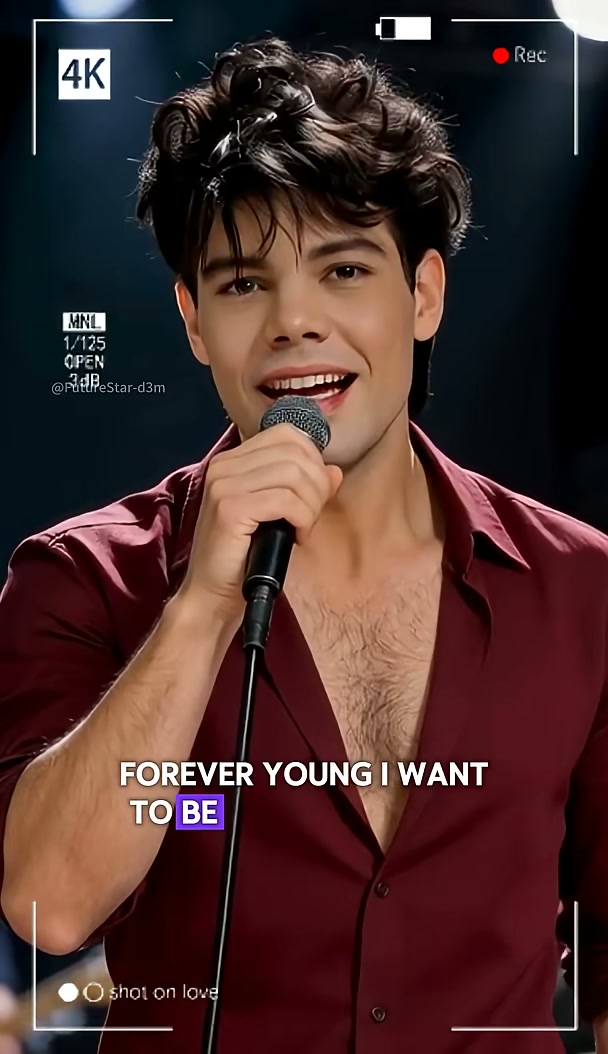
The refrain, “I want to be forever young,” remains effective because it is both simple and impossible. Its repetition transforms a private fear into a shared chant, allowing listeners to project their own memories and anxieties into the song.
In the context of an 80s-themed lyric video, that refrain carries added cultural resonance. Many viewers may associate the sound with school dances, first relationships, road trips, family memories, or the broader glow of a decade remembered through music and style.
The song’s synth pop atmosphere is central to that effect. Its polished melody, steady pulse, and wistful electronic textures create a sense of forward motion, even as the lyrics look backward or try to stop time.

This tension between movement and stillness gives the video its emotional charge. The music keeps advancing, but the words ask whether youth, dreams, and identity can somehow be preserved.
The imagery of youth as “diamonds in the sun” is especially telling. Diamonds suggest permanence and value, while sunlight suggests warmth and brilliance, so the phrase captures the dream that young life might remain radiant forever.
Yet the surrounding lyrics complicate that dream. They point toward missed adventures, songs left unsung or forgotten, and aspirations that may or may not come true.
That is why the video resonates beyond simple retro appreciation. It does not only remind viewers of a past era; it asks them to think about what they hoped for then, what changed, and what still feels unfinished.
The lyric format strengthens this introspective quality by slowing attention down. When the words are placed at the center, familiar lines can feel newly direct, especially for listeners who have heard the chorus for years without dwelling on the verses.
A strong lyric video often succeeds by making the audience listen more closely to what they thought they already knew. Here, the experience can turn a well-known anthem into something more intimate, almost like reading an old letter from a younger self.
The emotional arc is clear and effective. It begins with poetic reflection, moves into awareness of mortality, opens into anxiety about aging, and finally returns to the repeated wish to stay forever young.
That structure mirrors the way nostalgia often works in real life. A memory may begin with a song, a place, or a face, but it can quickly lead to larger thoughts about time, loss, and who a person used to be.
The video’s lack of a conventional plot is therefore not a weakness. Its purpose is not to explain events, but to create a mood in which viewers can supply their own personal stories.
For some, the song may evoke the original era of 1980s pop culture, with its bright production, romantic melancholy, and futuristic textures. For others, it may be tied to later moments, since the track has lived across generations through films, covers, playlists, and personal rituals.
That generational flexibility is part of the song’s lasting power. Even listeners who did not grow up in the 1980s can understand the wish behind the chorus, because the fear of losing youth is not limited to one decade.
The transcript’s references to unrealized dreams deepen the sense of emotional universality. Almost everyone carries some idea of an adventure not taken, a chance not seized, or a future that once seemed more open.
At the same time, the song is not purely pessimistic. Its repeated wish for dreams to come true keeps a small but important thread of hope alive.
That hope prevents the video from becoming only a lament. Even as it acknowledges fading and loss, it preserves the feeling that longing itself can be beautiful and that memory can keep certain parts of youth emotionally present.
The performance impact comes less from vocal spectacle than from melodic recognition and atmosphere. The chorus rises in a way that feels communal, as if the listener is being invited to join a feeling that many people have carried for decades.
This is why the song remains so effective in short-form and lyric-video settings. It can reach its emotional center quickly, because the refrain is already embedded in popular memory and needs only a few lines to reactivate that connection.
The video also benefits from the current appetite for nostalgic media. In a fast-moving digital culture, older songs often become anchors, giving viewers a brief chance to return to a sound world that feels more stable, sincere, or emotionally legible.
Still, the strongest response comes not from nostalgia alone, but from the song’s honesty about impermanence. The 1980s setting may provide the surface glow, but the deeper subject is the human desire to keep life from slipping away.
A balanced reading should note that the lyric video appears designed more as an emotional tribute than as a fresh reinterpretation. It relies on the existing power of the song, the familiarity of the refrain, and the audience’s willingness to bring personal meaning to the experience.
That reliance is not necessarily a flaw. With a song this widely recognized, restraint can be more effective than overexplaining, because the track already contains the emotional architecture needed to move listeners.
The result is a piece that functions like a memory trigger. It does not simply present lyrics on screen; it creates a space where viewers can revisit youth, measure distance from the past, and feel the ache of time passing.
By the end, the repeated desire to be forever young feels less like fantasy and more like confession. The video reminds audiences that youth cannot be preserved literally, but songs can keep its hopes, fears, and brightness alive in memory.