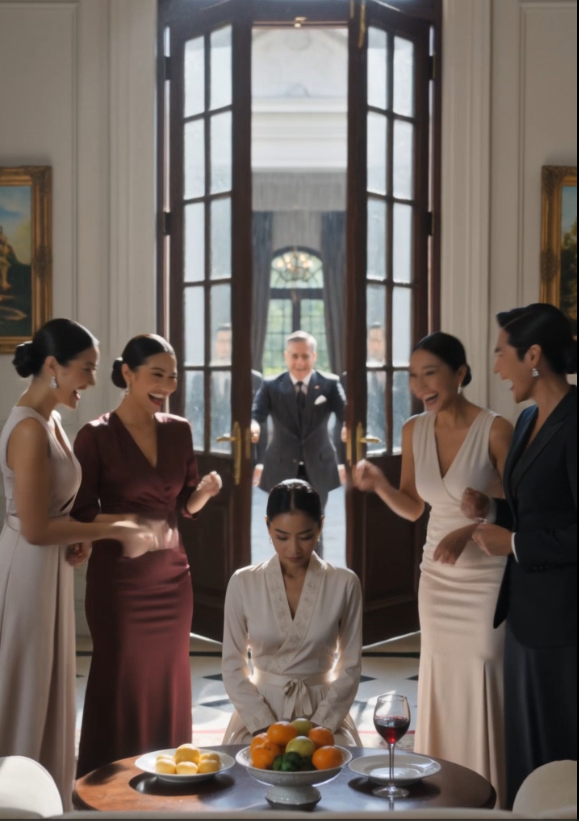
When Linh married into the Varel family, she did not bring a dowry that impressed anyone, a surname anyone respected, or the kind of polished upbringing that made old money feel safe. To them she was a mistake the youngest son had made out of sentiment. A poor girl with careful manners, a plain dress, and eyes that never lifted high enough to challenge the insults placed before her. What none of them knew was that her silence had never been emptiness; it had been discipline. And the day the truth of her birth stepped through the iron gates of that grand house, it did not simply elevate her. It revealed, with humiliating clarity, how small the people who had despised her truly were.
PART 1
The Varel estate stood on a ridge above the river, all terraces and carved balconies and old stone warmed to amber by the late sun, the kind of house that took itself very seriously because it had been admired for too long. Family portraits lined the central hall in gilt frames, every generation of men and women painted as though nobility were something that could be inherited through posture alone.
When Linh first walked through those doors as Adrian Varel’s new wife, the house did not feel hostile at once. It felt watchful. Hostility, she would later learn, took more pleasure in unfolding gradually.
The wedding had been private at Adrian’s insistence. He had married her quickly, stubbornly, and without consulting the many people who believed their opinions were the natural extension of his life. By the time the family gathered to meet her formally at the estate, their displeasure had already matured into narrative.
She was from nowhere important. She had been raised by a seamstress aunt after losing her parents young. She had once worked in a flower shop. She did not belong.
No one said all of this directly in the first hour. Old families were often too practiced to be crude too early. Instead they used softer knives. They asked where she had studied with a brightness that made plain her answer would disappoint them regardless.
They complimented how “simple” her dress was. They smiled at Adrian as though men sometimes did silly things before settling down correctly. His mother, Celeste Varel, kissed Linh’s cheek and said, “You must feel overwhelmed. Houses like this take getting used to.” The words sounded kind if one did not look too closely at the eyes delivering them.
Linh had grown up poor enough to understand humiliation when it wore perfume.
So she smiled, lowered her gaze, and answered every slight with such measured courtesy that it became difficult for anyone to accuse her of offense. She thanked the cook by name after her first dinner. She learned the household rhythms faster than the servants expected.
She sent flowers to Adrian’s grandmother with a hand written note after noticing the older woman’s room felt dim. She never interrupted, never displayed irritation, never reached above the place they had assigned her. To the family this restraint looked like weakness. In truth it was training. There were people who mistook quiet for lack of selfhood because they had only ever seen noise mistaken for power.
The insults sharpened by degrees.
At luncheon one afternoon, Adrian’s sister remarked that country girls often had a “natural talent” for pretending to be dazzled by silverware they did not understand. On another evening, Celeste asked in the presence of guests whether Linh found the cellar intimidating because she had “probably never seen so much wine in one place.
” At a charity reception, one of Adrian’s aunts commented on Linh’s hands—beautiful hands, she said, but working hands, unlike the hands of women raised properly. Each cruelty was polished, deniable, precise.
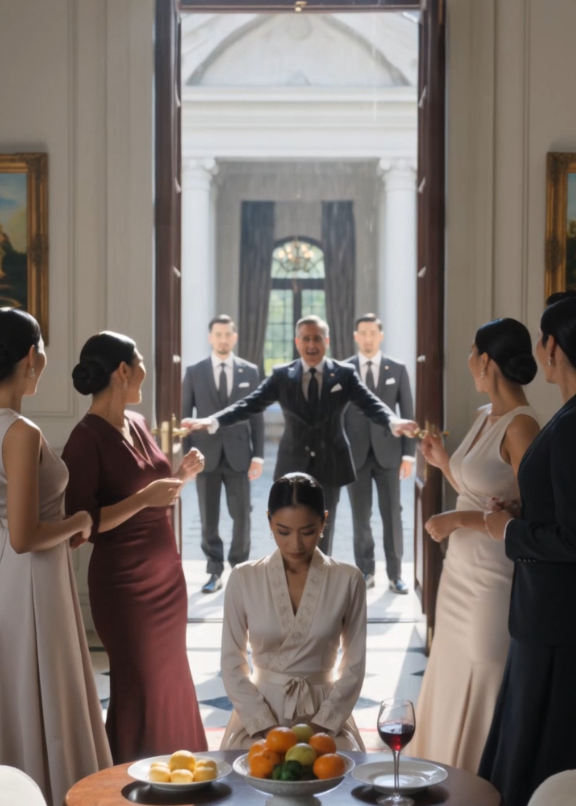
And yet Adrian defended her every time.
Not dramatically, not with theatrical declarations, but with the calm, deadly efficiency of a man who understood his family’s language and knew how to turn it back on them. When his brother implied the marriage had been impulsive, Adrian replied, “Yes. I saw honesty and decided not to delay.”
When his mother mocked Linh’s background, he said without looking up from his glass, “I prefer humility learned through hardship to entitlement learned at the table.” Even his silences became shields; he would cross a room to stand beside his wife in the middle of conversation, place a hand at the small of her back, and in doing so remind everyone that whatever contempt they harbored, they were directing it at the woman he had chosen.
Linh loved him for that, though she sometimes wished he did not have to spend so much of himself protecting what should have been met simply with decency.
There were things she did not tell him.
Not because she doubted him, but because secrecy had shaped the edges of her life long before she entered his. The woman who raised her had never lied exactly; she had only omitted. Your parents died in an accident. We moved. It is better not to ask too many questions about people who can no longer answer them.
Linh grew up with documents that seemed correct but thin, a childhood that carried small peculiar absences, and one object kept hidden in an old lacquer box wrapped in cloth: a signet ring bearing the crest of a corporate dynasty too distant from her life to feel real.
Her aunt had once told her, when Linh was seventeen and angry enough to demand the truth, “There are families whose love arrives as ownership. If they find you before they have learned regret, they will not protect you. Let the past sleep.”
So Linh had let it sleep.
Until the day it no longer wished to.
It was late autumn when the fractures began to widen. The wind had stripped half the leaves from the cypress drive, and the sky over the estate remained colorless for days, giving the entire house the hard stillness of something waiting. Adrian had left for a three-day business summit abroad. Celeste used his absence with the confidence of someone who understood exactly how far she could go when the son most likely to oppose her was not present.
By then the household no longer bothered with disguising its contempt consistently. Linh’s breakfast was sent up cold twice. Instructions she gave to the staff were quietly overridden. At dinner, Celeste announced before a full table that some women married for love while others married for rescue. No one challenged her. The implication settled across the linen like dust.
Linh put down her spoon carefully. “And some mothers,” she said gently, “raise sons brave enough to choose love even when comfort would have pleased everyone else.”
Silence followed, immediate and severe.
Celeste’s face did not change, which only made the fury beneath it more visible. “You have become bolder.”
“No,” Linh answered. “Only less afraid.”
The next afternoon Celeste called her to the blue salon under the pretense of discussing the winter charity calendar. Rain pressed faintly against the tall windows. The room smelled of lilies and old upholstery. When Linh entered, she found not only Celeste there but Adrian’s sister, his aunt, and two women from their social circle whose chief talent lay in remembering the humiliations of others for entertainment.
“Sit,” Celeste said.
Linh remained standing.
“I prefer to stand.”
Something like approval flickered in one of the other women’s eyes, but it vanished before it could become useful.
Celeste folded her gloves on her lap with maddening neatness. “You should understand the reality of your position. Adrian is affectionate, yes, but infatuations do not alter blood. You can learn the rules, wear the jewels, host the dinners, and none of it will make you one of us.”
Rain ran down the glass in long silver lines behind her. Linh thought, absurdly, of the flower shop where she had once worked, of mornings spent trimming stems while dawn light slowly turned buckets of water into gold. There had been peace in that life despite its smallness. Standing in the blue salon, surrounded by expensive cruelty, she realized that wealth without grace produced an ugliness poverty rarely had time to perfect.
“I have never tried to be one of you,” she said.
That answer landed more sharply than anger would have.
Celeste rose. “You should.”
“Why?”
“Because otherwise you are nothing here.”
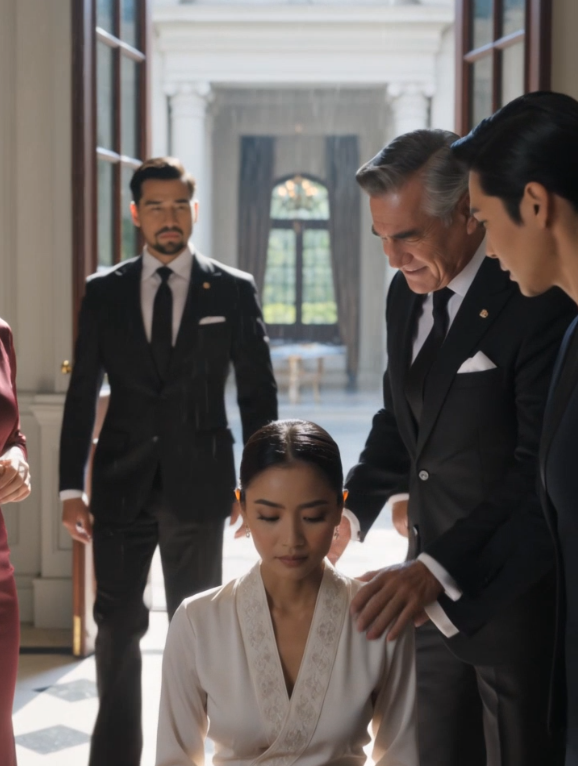
Linh was about to reply when footsteps sounded in the main hall—not hesitant footsteps, not domestic ones, but the measured, coordinated movement of several men accustomed to being admitted everywhere they went. The salon door opened before anyone inside could object. The butler, whose face had gone strangely pale, stepped aside to allow three men in dark suits to enter.
The room changed instantly.
Not in the superficial way people describe tension, but in the deeper sense that the hierarchy everyone had been relying on suddenly no longer obeyed them.
The oldest of the three men carried himself with quiet authority rather than performative power. Silver threaded his hair. Rain darkened the shoulders of his overcoat. He looked first at the assembled women, then at Linh.
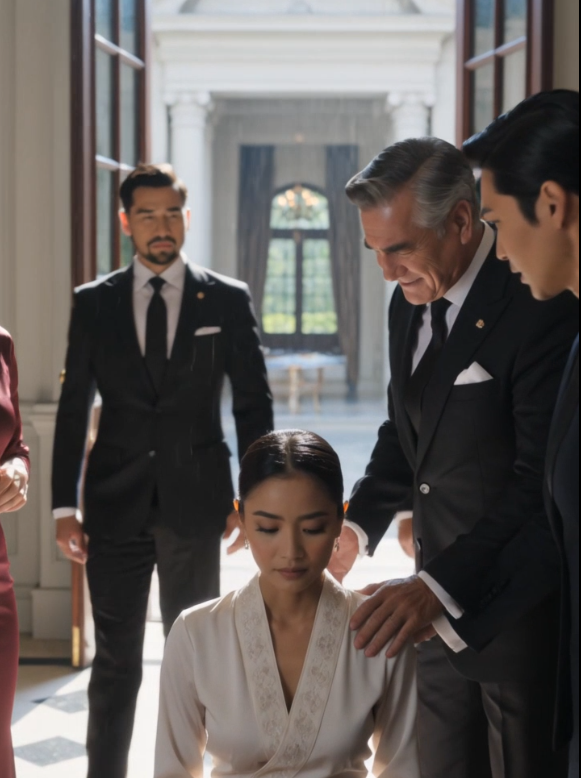
And in his face she saw a resemblance so distant yet undeniable that the world seemed, for one disorienting second, to slip sideways.
“Miss An Linh Tran,” he said softly.
No one in the room had ever used her full birth name.
Celeste stiffened. “I’m sorry, who exactly are you?”
The man ignored the interruption. His eyes remained on Linh, and when he spoke again there was unmistakable regret in his voice, old enough to have deep roots. “I am Minh Quang Tran. Your grandfather.”
No one moved.
The silence that followed did not feel empty. It felt enormous.
Linh’s throat tightened. She had imagined this possibility in abstract forms over the years—a forgotten branch of family, a buried inheritance, a truth deferred. She had never imagined it arriving in the middle of a room where people had just informed her she was nothing.
Celeste laughed once, too lightly. “This is absurd.”
Mr. Tran turned then, and whatever authority his name carried became visible in the immediate caution that entered every face. Even the socialite guests recognized it. In Vietnam and far beyond, the Tran Group name was not simply wealthy. It belonged to the kind of industrial and financial empire newspapers described with phrases like untouchable, generational, state-shaping. It was the name behind ports, energy holdings, hospitals, technology firms, scholarships, foundations. It was the sort of name people spoke carefully because entire sectors bent around it.
“This,” he said evenly, “is long overdue. Not absurd.”
Linh found her voice only with difficulty. “My aunt told me my parents were dead.”
“They are,” he said, and grief shadowed his features at once. “My son and your mother died believing distance would protect you from enemies they had already underestimated. When the accident happened, we lost more than they knew.
I searched, but the woman who took you feared my world more than she trusted it. By the time I found the trail again, you were grown. I chose not to force my way into your life from behind. That was my cowardice. And perhaps my punishment.”
Celeste sat down without seeming aware she had done so.
One of the other women whispered, “Dear God.”
Linh stood very still, feeling years rearrange themselves inside her with almost physical force. Memory rose strangely then—not grand revelations, but details: the quality of the ring in the lacquer box, her aunt’s guarded silences, the way older strangers had occasionally stared at her too long in public as though trying to place a face they had seen elsewhere. A hidden world, all this time, had not been absent. It had merely been waiting.
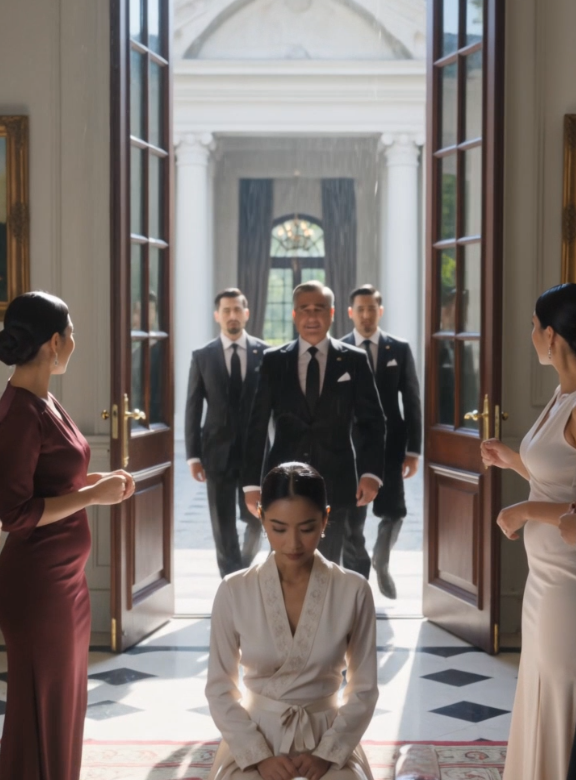
Adrian returned that evening to find the house transformed. The staff moved as if aware history had entered and taken a seat. Cars lined the drive. Security men stood discreetly near the main hall. In the drawing room, beneath the portrait of his great-grandfather, he found his wife seated beside a man whose presence could not be mistaken for ordinary importance.
Cholesterol stood at the far side of the room, pale and rigid. For the first time since Linh had crossed that threshold, no one looked at her as though she needed permission to occupy the space.
Adrian went straight to her.
“What happened?”
Linh looked up at him, and though emotion had left her eyes bright, her voice was calm. “It seems,” she said, “I have finally been introduced to my family.”
He understood enough from the room to know the sentence meant more than it appeared to. When the truth was explained, he did not look shocked for long. Instead he looked toward the women who had spent months measuring his wife against their own narrow definitions of worth, and the contempt in his gaze was so quiet it was almost elegant.
No grand revenge followed.
That was not Linh’s style.
She did not humiliate them because she no longer needed to. Their own memory would do it better. Every insult they had offered now stood exposed not because she had become more valuable overnight, but because the poverty they had mocked had never diminished her, and the grandeur they worshipped had failed to make them generous. The revelation of her birth did not create her dignity. It only forced others to acknowledge what they should have recognized without pedigree.
Weeks later, after the lawyers, reunions, histories, and newspapers had all had their turn, Linh stood alone for a moment on the east terrace at dusk. The river below held the last of the light in narrow strips of bronze. The wind smelled faintly of rain. Adrian came to stand beside her and slipped his hand into hers.
“Are you angry?” he asked.
She thought about it.
“At them?” she said. “A little.”
“At yourself?”
“For not knowing?”
He nodded.
Linh looked out over the darkening grounds. “No. There is a kind of freedom in being loved before anyone realizes what your name can buy.”
Adrian smiled faintly. “And now?”
“Now,” she said, resting her head briefly against his shoulder, “I know exactly who I am. Which means other people’s confusion is no longer my burden.”
Below them the house glowed from within, grand as ever, but changed now because the illusions inside it had thinned. Somewhere behind them, servants carried in tea. Somewhere upstairs, Celeste Varel sat alone with the knowledge that all her refinement had not prevented vulgarity of spirit. And beside Linh stood the one person who had seen her clearly before the world corrected itself.
In the end, that mattered more than inheritance.
Yet there was still something exquisitely just in the fact that the woman they had tried to make feel small had not risen by becoming someone else.
She had simply been revealed.